
Key Points
- Oracle’s fiscal Q1 2027 revenue rose 30% year over year, while Oracle Cloud Infrastructure revenue climbed 121% to $7.4 billion.
- Trade flows records show a growing concentration of processing, storage and networking equipment around Oracle’s infrastructure expansion.
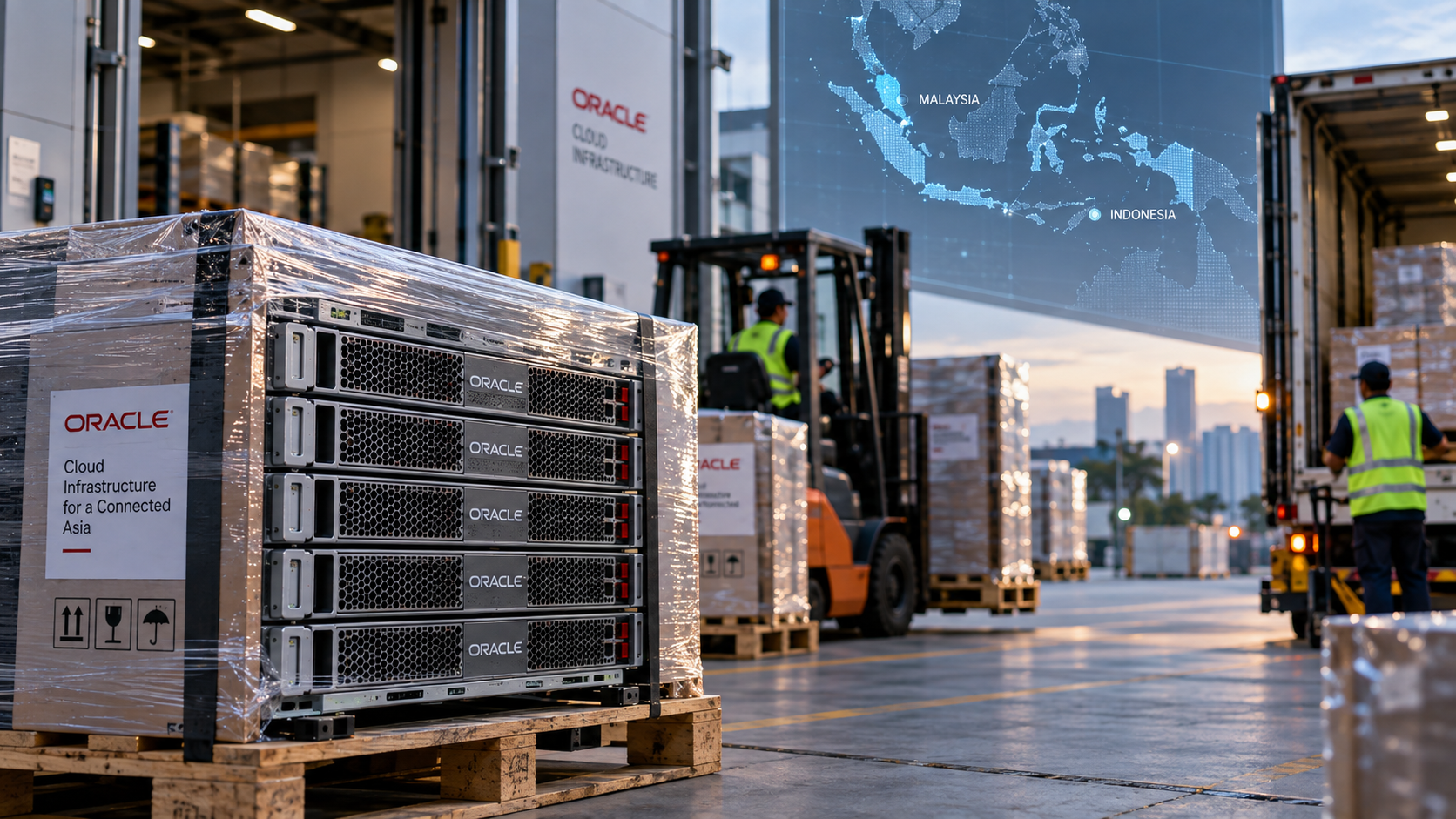
- Malaysia and Indonesia stand out, with hardware flows that align closely with Oracle’s expansion of OCI capacity across Southeast Asia.
- The same growth is making Oracle far more capital intensive, with sharply higher infrastructure spending, negative free cash flow and rising costs inside the cloud business.
The Hardware Behind Oracle’s OCI Expansion
Fiscal Q1 2027 revenue rose 30% year over year to $19.3 billion, while cloud revenue increased 62% to $11.6 billion. The biggest change came from Oracle Cloud Infrastructure. IaaS revenue more than doubled, rising 121% to $7.4 billion, compared with 10% growth in cloud applications and a 3% decline in software revenue.
That growth requires physical capacity. Oracle added another 850MW of data-center capacity during the quarter, while servers, networking equipment and data-center construction now account for a large part of its investment program.
Three selected infrastructure categories alone accounted for approximately $350 million of recorded B2B trade flows activity associated with Oracle as buyer in 2025, according to TenderAlpha’s global trade flows data.
Table 1: Selected Oracle Infrastructure-Related B2B Trade Flows, 2025
| HS code | Product category | 2025 recorded value |
|---|---|---|
| 847150 | Processing units | $283.5m |
| 851762 | Networking, switching and routing equipment | $38.7m |
| 847170 | Storage units | $27.6m |
| Total | Selected infrastructure categories | $349.8m |
Source: TenderAlpha Pro. 2025 buyer-side Shipping Data across HS 847150, 847170 and 851762.
This is a deliberately narrow slice of Oracle’s broader trade flows activity. Its value is in the product-level detail: the equipment involved, where it is moving and which companies appear around those flows.
Malaysia: Compute, Networking and Fiber Around OCI Expansion
Oracle committed more than $6.5 billion to expanding AI and cloud infrastructure in Malaysia. TenderAlpha records substantial Malaysia-linked activity in 2025, dominated by processing units, networking and switching equipment, and optical-fiber infrastructure.
The mix fits a large-scale cloud buildout: compute capacity, network infrastructure and physical connectivity. The largest recorded corridor by value runs from the United States into Malaysia, while Taiwan also appears as an important equipment origin.
The timing is just as interesting. Activity builds sharply through the middle of 2025 and remains elevated around the expansion of OCI capacity in Kulai, where Malaysia West 2 became available in February 2026.
TenderAlpha also picks up part of the surrounding manufacturing network. GES Manufacturing Services appears in the Malaysia-linked records, and its Senai, Johor plant is listed as a factory for Oracle America equipment.
That combination of compute, networking, fiber and manufacturing activity gives the Malaysia data considerably more depth than a simple increase in recorded trade value.
Indonesia: Processing Units Around the Batam Expansion
Indonesia tells a slightly different story.
Oracle opened its Indonesia North OCI region in Batam in May 2025. Around the same period, processing units become particularly prominent in TenderAlpha’s Indonesia-linked data. Roughly $121 million of recorded buyer-side activity in 2025 falls under HS 847150 alone.
The counterparties make the pattern more concrete. TenderAlpha records about $74 million across 20 processing-unit records involving Ingrasys Technology USA between June and August 2025, immediately after the Batam region opened. Ingrasys specializes in cloud infrastructure, GPU platforms and rack-scale AI systems.
The pattern continues into 2026. In May, TenderAlpha records 85 Quanta Computer processing-unit records along a Taiwan–Indonesia corridor. Quanta’s data-center portfolio includes servers, storage devices and network switches used by cloud service providers.
Around and after the Batam launch, TenderAlpha therefore records concentrated flows of the kind of hardware used to scale cloud infrastructure, involving companies whose core businesses sit firmly inside the data-center supply chain.
OCI Is Changing Oracle’s Financial Profile
Oracle’s financial mix is shifting at the same time.
Table 2: Oracle Q1 FY2027 Financial and Cloud Performance
| Q1 FY2027 metric | Result | Y/Y change |
|---|---|---|
| Total revenue | $19.3bn | 30% |
| Cloud revenue | $11.6bn | 62% |
| OCI / IaaS revenue | $7.4bn | 121% |
| Cloud applications / SaaS | $4.2bn | 10% |
| Software revenue | $5.5bn | -3% |
| Non-GAAP EPS | $1.92 | 30% |
Source: Oracle Q1 FY2027 results.
OCI is no longer simply one contributor to Oracle’s growth. It is increasingly the part of the business changing how Oracle grows.
Remaining performance obligations reached $664 billion at the end of August. Only part of that balance will convert into revenue over the next 12 months, but its scale helps put Oracle’s infrastructure buildout in context.
The trade flows evidence adds a physical layer to that shift. Processing, storage and networking equipment are becoming more prominent around Oracle at the same time that infrastructure is taking a much larger role in the company’s operating model.
The Cost of Scaling OCI
The other side of the story is the amount of capital required to keep up.
Oracle spent $28.5 billion on capital expenditures in Q1 FY2027, up from $8.5 billion a year earlier. Construction in progress reached $48.5 billion, primarily covering servers, networking equipment and data-center improvements.
Operating cash flow reached $23.1 billion, but free cash flow was still negative $5.4 billion because capital spending ran even higher. Oracle also raised roughly $20 billion through equity issuance during the quarter. Customer prepayments with a significant financing component reduced the quarter’s net cash outlay for capital expenditures by another $11.4 billion.
Costs inside the cloud and software business are rising as well. Cloud and software expenses increased 82% year over year, while the business’s margin fell from 60% to 55%. Absolute margin dollars still grew because revenue increased so quickly, but OCI’s rapid scaling is making Oracle a more infrastructure-heavy business with economics that look different from the software model that historically dominated the company.
The challenge now is execution. Oracle has plenty of demand to build for. It still has to turn that capacity into revenue fast enough to justify the spending behind it.
Conclusion
Oracle’s cloud story is no longer just a revenue story. It is a physical infrastructure buildout on a huge scale.
TenderAlpha’s B2B trade flows records make part of that expansion visible through processing, storage, networking and fiber activity, with Malaysia and Indonesia offering particularly clear examples of how OCI growth is showing up beyond the financial statements.
The harder test is what comes next: turning this infrastructure build into sustained revenue, margins and cash generation.
Explore the trade flows and counterparties behind Oracle’s infrastructure expansion in TenderAlpha Pro. Request a demo.
This article is provided for informational purposes only and does not constitute investment advice or a recommendation to buy, sell or hold any security.