
Executive Summary
MARA Holdings is widely followed for its large-scale bitcoin-mining operations, but the company is increasingly relevant to a broader infrastructure discussion: power-dense computing, data centers and the supply chains required to operate them.
As data-center development becomes increasingly shaped by power availability, cooling requirements and site control, MARA offers a useful case study in how compute infrastructure can be observed through company-level B2B relationships. For investors and corporate readers, the important question is not only what MARA says about its strategy, but what its supplier network reveals about the equipment, routes and asset relationships behind that strategy.
TenderAlpha’s buyer-side B2B data helps connect those pieces by showing cross-border equipment movement at supplier, product and route level, while its B2B Announcements data adds the domestic relationship layer behind data-center and powered-site expansion.
That domestic layer now includes several notable relationships: the $87.3 million Garden City, Texas data-center relationship with APLD – Rattlesnake Den I LLC, the Starwood strategic agreement targeting approximately 1 GW of near-term IT capacity with a pathway to more than 2.5 GW, the approximately $1.5 billion Long Ridge Energy & Power transaction, and the Matagorda County powered-land relationship with HIF USA tied to up to 2 GW of power capacity.
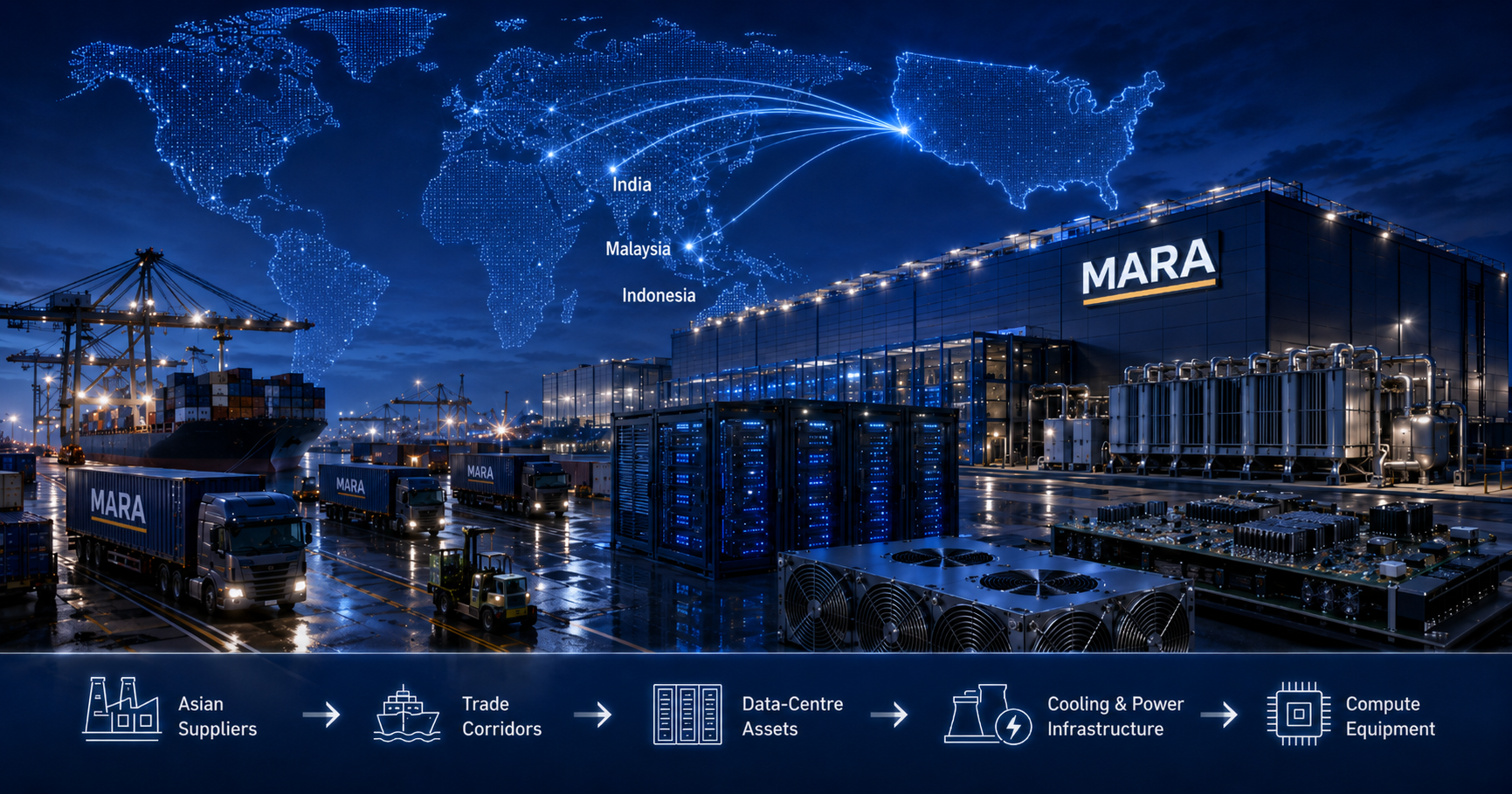
MARA’s cross-border procurement reveals two complementary supply-chain channels: large-scale compute equipment sourced through Asian electronics manufacturers, and cooling, thermal-management and electrical infrastructure supplied largely from India. Together with the domestic data-center and powered-site relationships captured in TenderAlpha’s B2B Announcements data, these flows illustrate how MARA is building a broader data-center platform capable of supporting increasingly demanding computing workloads.
MARA’s Supplier Network Has Three Visible Layers
The supplier network is best understood as three connected layers rather than as a single purchasing category. The first layer supplies compute equipment. The second supports the operating environment around that equipment. The third captures domestic data-center and powered-site relationships that do not appear in customs records but are visible through TenderAlpha’s B2B Announcements data.
Table 1: Three Layers in MARA’s Supplier Network
| Layer | Main geography | TenderAlpha signal | Strategic role |
|---|---|---|---|
| Asian compute-equipment flows | Malaysia and Indonesia | Recurring purchases from electronics manufacturers | Installed compute and deployment layer |
| Thermal and power infrastructure | India, with some German activity | Cooling, pumping, heat exchange and electrical-control equipment | Facility operating layer |
| Domestic data-center and power-asset relationships | United States | Garden City, Starwood, Long Ridge and Matagorda relationships | Site ownership, power access and development pathway |
Source: TenderAlpha Pro
This layered view is useful because data-center platforms are not built from one input alone. Compute units, cooling systems, electrical controls, powered sites and domestic asset relationships all sit inside the same operating stack. For investment and corporate analysis, the benefit is the ability to monitor how those layers develop together, rather than relying only on company-level descriptions or broad industry labels.
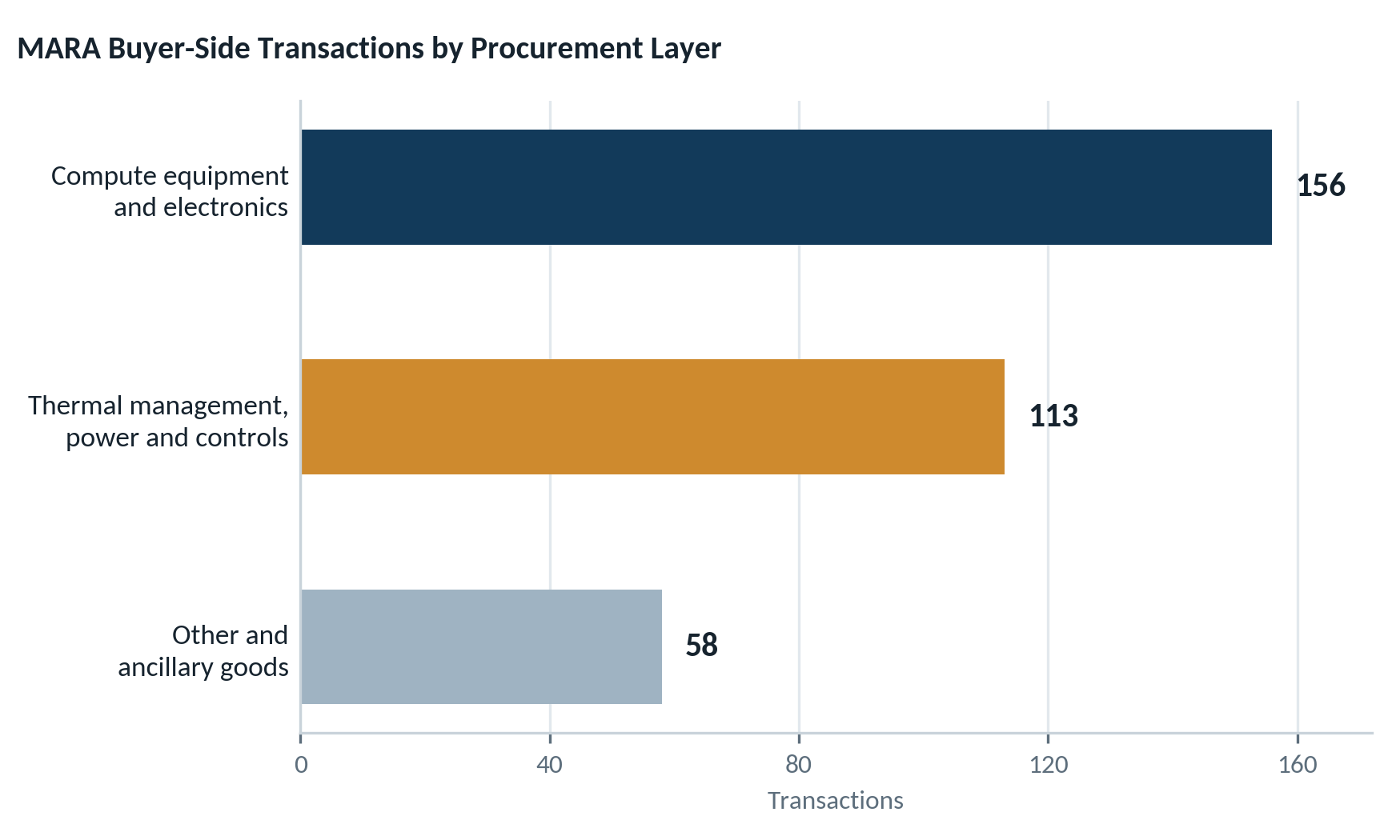
Figure 1: MARA Buyer-Side Transactions by Procurement Layer
Source: TenderAlpha Pro
Asia Equipment Flows Show a Changing Supplier Pattern
The Asian equipment channel is the largest part of MARA’s buyer-side trade activity by transaction value. HS 854370 (electrical machines and apparatus with individual functions) is the dominant customs category, but the supplier-level view is what makes the category actionable: the equipment flows are concentrated among a small set of recurring electronics manufacturers in Malaysia and Indonesia. TenderAlpha’s B2B global trade flows data identifies $99.9 million across 136 HS 854370 (electrical machines and apparatus with individual functions) transactions connected to five leading Asian suppliers. This concentration makes it easier to monitor which manufacturers are becoming more important, when they appear in the data and which routes they use.
Table 2: Leading Asian Equipment Suppliers in MARA Buyer-Side Transactions
| Supplier | Country | Main activity | Transactions | Transaction value |
|---|---|---|---|---|
| Xinglian Technology | Malaysia | Electronics and complete-machine assembly | 43 | $34.3m |
| Likom CMS | Malaysia | Contract electronics and system assembly | 36 | $30.7m |
| SMT Technologies | Malaysia | Electronics manufacturing services | 14 | $18.9m |
| PT Aohai Technology Indonesia | Indonesia | Power-electronics manufacturing | 20 | $8.7m |
| PAN International Electronics | Malaysia | PCB assembly and box-build manufacturing | 23 | $7.2m |
Source: TenderAlpha Pro
The supplier mix changes over time. PT Aohai and PAN International are most visible in the first major wave in February 2025. SMT Technologies becomes prominent in June and July. Xinglian Technology and Likom CMS then dominate the larger late-2025 and early-2026 flows. For users monitoring suppliers, that sequence is more useful than a static annual total because it shows when specific manufacturer relationships begin to scale.
Table 3: Asian Equipment Procurement Waves
| Period | Leading suppliers | Main route pattern | Transactions | Transaction value | What TenderAlpha detects |
|---|---|---|---|---|---|
| February 2025 | PT Aohai; PAN International | Indonesia and Penang-linked flows | 37 | $13.9m | First major Asian equipment wave |
| June-July 2025 | SMT Technologies | Penang-linked flows | 9 | $10.8m | Mid-year supplier shift |
| November 2025 | Likom; Xinglian; SMT | Kampong Tanjong Kupang and Singapore-linked flows | 36 | $32.6m | Largest monthly equipment wave |
| December 2025-January 2026 | Xinglian; Likom | Kampong Tanjong Kupang to Los Angeles | 43 | $38.5m | Continued high-volume Malaysian equipment flow |
Source: TenderAlpha Pro
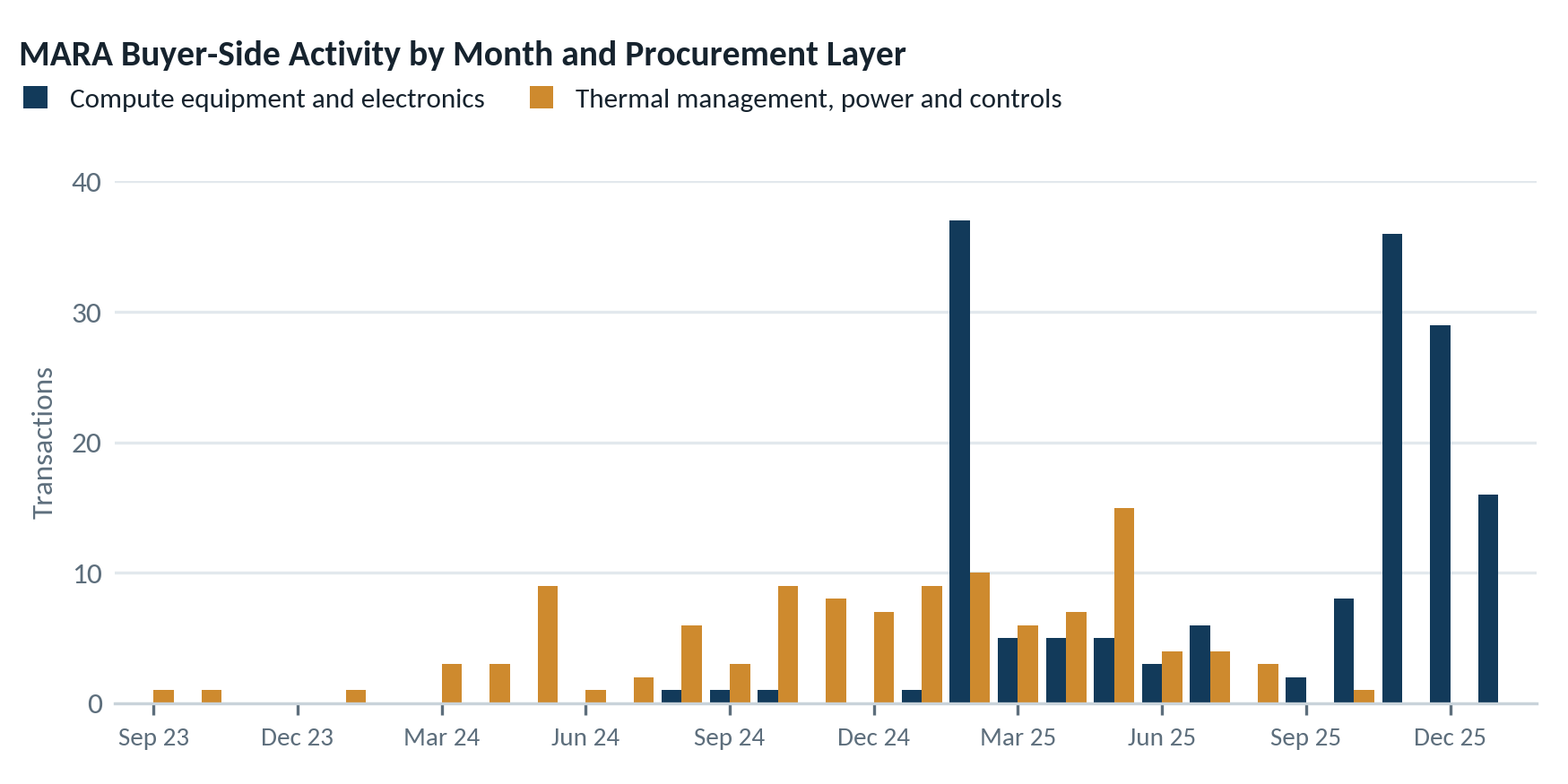
Figure 2: MARA Buyer-Side Activity by Month and Procurement Layer
Source: TenderAlpha Pro
Thermal and Power-Control Flows Reinforce the Operating Layer
The second supply-chain channel is smaller by transaction value, but highly relevant to the data-center interpretation. TenderAlpha captures 113 transactions involving thermal-management or power-control categories, equal to roughly 35% of MARA’s buyer-side records.
The category mix shown in Figure 3 covers the physical systems that help operate power-dense facilities, including refrigeration and heat-pump parts, electrical-control and distribution cabinets, heat-exchange units, evaporative air coolers, fans and centrifugal pumps. The leading suppliers are mainly Indian companies, including Shreeji Incorporation and Natasha Fin Tubes, with a smaller German cooling-equipment channel also visible.
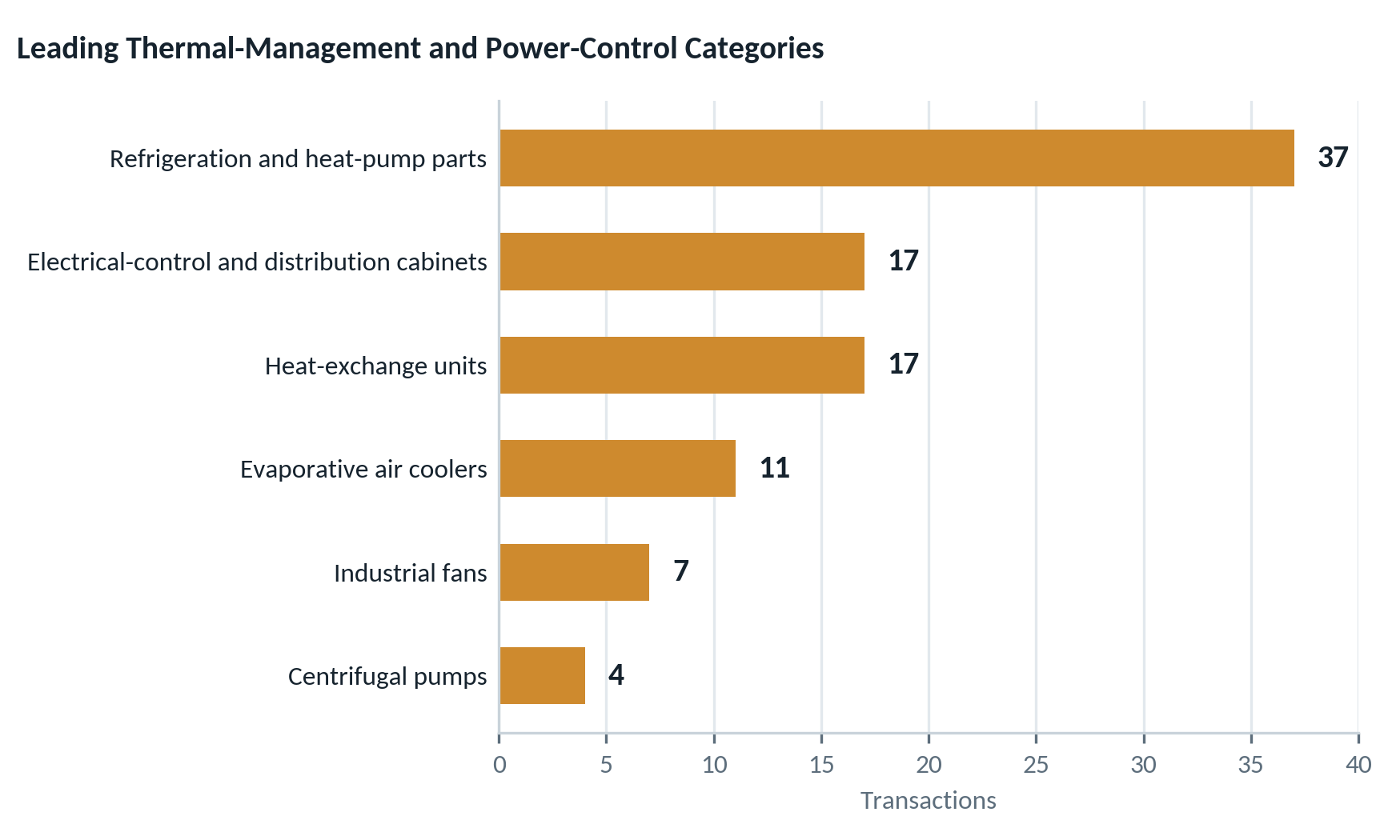
Figure 3: Leading Thermal-Management and Power-Control Categories
Source: TenderAlpha Pro
The operational relevance is clear. Heat exchangers remove heat, pumps circulate fluids, fans and coolers reject heat, and electrical cabinets help control and distribute power. In practice, these are the systems that allow dense computing equipment to run continuously inside a facility, regardless of the specific workload running on the machines.
Port-Level Data Separates the Functions of MARA’s Supply Chain
TenderAlpha’s port-level fields turn the supplier view into route-level intelligence. For investors and corporate strategy teams, that matters because supplier country alone cannot show where flows consolidate, which U.S. destinations receive the goods or whether different routes are serving different operating functions.
Table 4: Leading Points of Lading by Observed Role
| Point of lading | Country | Transactions | Transaction value | Main observed role |
|---|---|---|---|---|
| Kampong Tanjong Kupang, Johor | Malaysia | 79 | $71.2m | Compute equipment |
| Penang / George Town | Malaysia | 30 | $18.0m | Compute equipment |
| Jawaharlal Nehru Port / Nhava Sheva | India | 79 | $3.4m | Cooling, pumping and controls |
| Mumbai | India | 15 | $274.8k | Heat exchangers |
| Ahmedabad | India | 11 | $187.8k | Electrical and cooling equipment |
Source: TenderAlpha Pro
The lading-point view highlights a clear division. Kampong Tanjong Kupang and Penang / George Town are associated with high-value Asian compute-equipment flows. Jawaharlal Nehru Port / Nhava Sheva, Mumbai and Ahmedabad are more closely associated with cooling, pumping, heat-exchange and electrical-control equipment from India.
Table 5: Leading MARA Trade Corridors
| Point of lading -> point of unlading | Transactions | Transaction value | Leading suppliers | Principal observed role |
|---|---|---|---|---|
| Kampong Tanjong Kupang, Johor (Malaysia) -> Los Angeles, CA | 72 | $61.8m | Xinglian; Likom | Largest compute-equipment corridor |
| Penang / George Town (Malaysia) -> Dallas-Fort Worth, TX | 18 | $14.6m | SMT; PAN International | Earlier electronics-equipment route |
| Jawaharlal Nehru Port / Nhava Sheva (India) -> Houston, TX | 60 | $2.6m | Shreeji Incorporation | Cooling, pumping and electrical controls |
| Mumbai (India) -> Seattle-Tacoma, WA | 15 | $274.8k | Natasha Fin Tubes | Heat exchangers and temperature-treatment equipment |
Source: TenderAlpha Pro
The corridor split is one of the most useful findings in the data. The two Malaysia-United States corridors carry a combined $76.4 million across 90 transactions, while the India-United States routes carry equipment with a different operational profile. Kampong Tanjong Kupang to Los Angeles is the largest corridor, with $61.8 million led by Xinglian and Likom. Penang / George Town to Dallas-Fort Worth contributes another $14.6 million, led by SMT and PAN International. By contrast, the Jawaharlal Nehru Port / Nhava Sheva to Houston corridor is centered on Shreeji and covers cooling, pumping and electrical-control equipment. For users tracking infrastructure buildout, this route-level separation is the real analytical gain. It shows that MARA’s supplier network is not only concentrated by vendor, but also organized by logistics lane and equipment function.
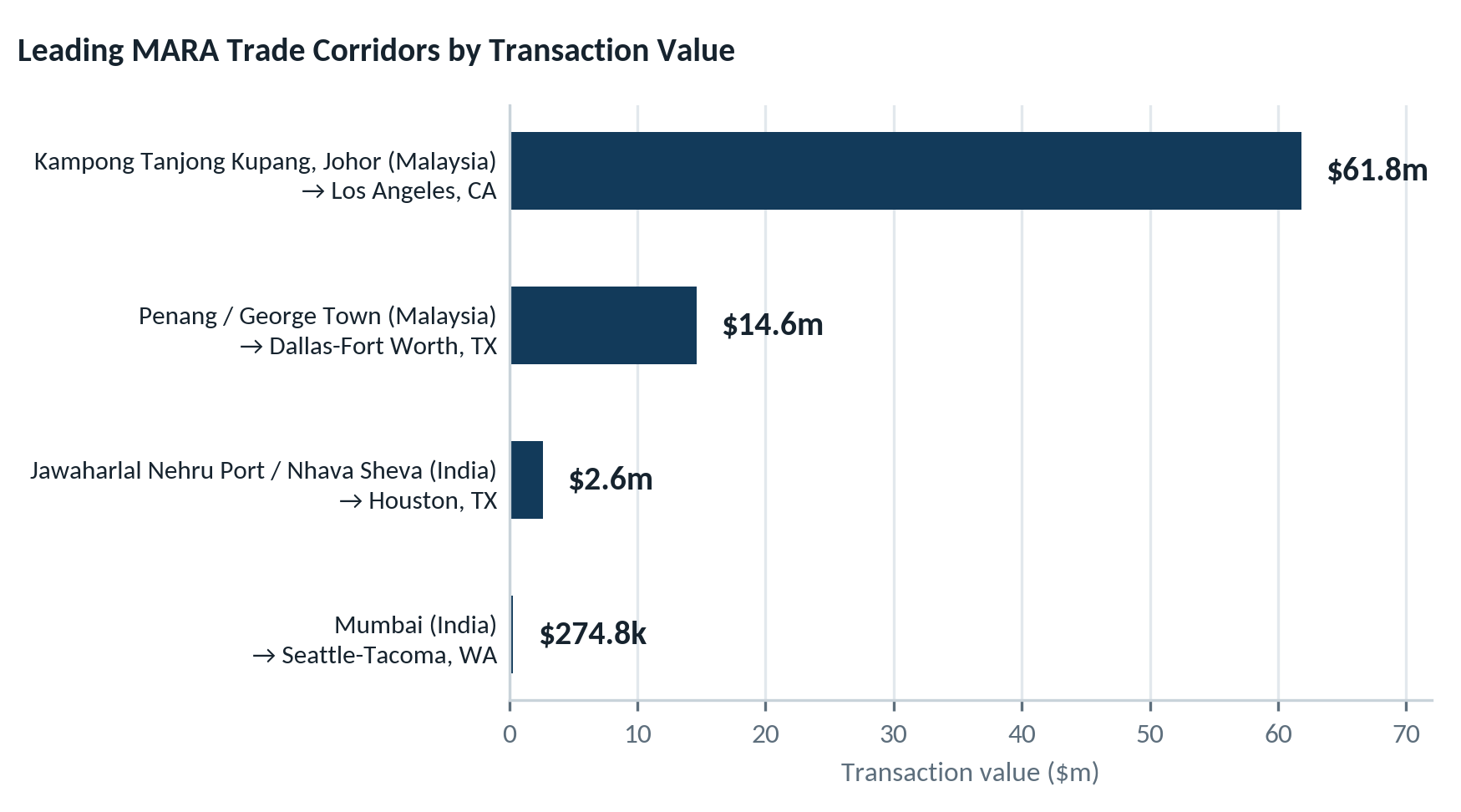
Figure 4: Leading MARA Trade Corridors by Transaction Value
Source: TenderAlpha Pro
Domestic Data-Center and Power Assets Add the Relationship Layer
The domestic side of the data-center story appears through TenderAlpha’s B2B Announcements data. For MARA, this layer now includes site acquisitions, development partnerships and powered-land relationships that complement the equipment flows visible in customs-based trade records. Beyond Garden City, the three newer announcements broaden the domestic data-center layer in different ways: Starwood points to development capacity and operating partnership, Long Ridge brings power generation and industrial land into the picture, and the HIF relationship adds a large Texas powered-land site with multi-gigawatt potential.
Table 6: MARA Domestic Data-Center and Powered-Site Relationships in TenderAlpha B2B Announcements Data
| Relationship | Date | Reported value / scale | Asset or role |
|---|---|---|---|
| APLD – Rattlesnake Den I LLC / MARA Garden City LLC | March 14, 2024 | $87.3m | Garden City, Texas data-center facility and associated ground lease |
| Starwood Capital Group / Starwood Digital Ventures / MARA | February 26, 2026 | ~1 GW near-term IT capacity; pathway to >2.5 GW | Strategic agreement to develop, finance and operate digital infrastructure across select MARA sites |
| FTAI Infrastructure / Long Ridge Energy & Power / MARA | April 30, 2026 | ~$1.5bn transaction value | 505 MW gas plant, more than 1,600 acres in Hannibal, Ohio and a potential AI / critical IT campus |
| HIF USA / Volt Texas LLC / MARA | July 2, 2026 | Up to $600.0m milestone-based purchase price; up to 2 GW power capacity | More than 1,200-acre powered land site in Matagorda County, Texas |
Source: TenderAlpha Pro
These relationships complement the trade-flow analysis because they capture a different layer of MARA’s B2B activity. Garden City reflects an operating data-center asset acquisition, Starwood adds a development and operating partner for digital infrastructure projects, Long Ridge adds an energy-backed campus opportunity in Ohio, and the HIF relationship adds a large powered-land position in Texas.
Customs records show equipment moving across borders; B2B Announcements data helps connect those flows with the site, power and partnership relationships behind data-center facilities.
The relationship layer is not a record-level match to individual shipments. Its value is broader: it connects imported equipment visibility with domestic site-level activity, giving readers a fuller view of how supplier flows, power assets and development partnerships sit inside the same infrastructure strategy.
Interpreting the Supplier Network
The first signal is supplier specialization. MARA’s supplier network combines concentrated Asian equipment flows with a separate India-centered thermal and power-control channel. That distinction makes the procurement picture more informative than a single HS-code or country-level view.
The second signal is route specialization. Kampong Tanjong Kupang and Penang / George Town are associated with compute-equipment flows, while Jawaharlal Nehru Port / Nhava Sheva, Mumbai and Ahmedabad are tied more closely to facility-enabling infrastructure. For readers assessing capacity buildout, this helps separate equipment deployment from the operating systems around it.
The third signal is the link between cross-border equipment and domestic asset relationships. Garden City, Starwood, Long Ridge and Matagorda add a U.S. data-center and powered-site layer to the supplier and logistics view, while future records involving high-density server systems, networking equipment, liquid-cooling components, UPS equipment or additional domestic data-center relationships would provide further evidence of how the platform is evolving.
Contact us to request a TenderAlpha Pro demo and explore company-level transaction signals across global buyer-supplier networks.
Disclaimer: This content is for informational purposes only and does not constitute investment advice, a recommendation, or an offer to buy or sell any security.