

NASA accounts for 82.55% of the total potential value of government contracts awarded to Blue Origin, LLC since 2010, according to TenderAlpha Pro. That represents approximately $3.15 billion out of $3.8 billion, underscoring the agency’s central role in the company’s recorded government contracting activity.
NASA’s latest lunar-delivery order, worth up to $234.2 million, adds to a period of rising contract award values for Blue Origin, LLC. The annual total potential value of its government awards has reached $1.59 billion in 2026 year-to-date, compared with $938 million in 2025.
This week’s G2B Sales Pulse also examines NASA’s commercial space communications contract with Viasat, government service awards and supplier selections across Europe, and three open procurement opportunities spanning Dutch defence facilities, school cleaning in England and healthcare construction services in Spain’s Canary Islands.
This Week at a Glance
| Type | Opportunity | Buyer/Country | Value | Term/Deadline | Commercial Signal |
|---|---|---|---|---|---|
| Award | Blue Origin – Lunar Delivery Order | NASA / US | Up to $234.2M | Awarded 2 Nov 2026; lunar delivery targeted for late 2028 | NASA accounts for 82.55% of Blue Origin, LLC’s recorded government contract potential value since 2010, according to TenderAlpha Pro. |
| Award | Viasat – Project NEXUS Space Communications | NASA / US | Up to $460.91M | Initial phase through May 2027; options through 2029 | Backward-compatible satellite relay development supports NASA’s transition toward commercial space communications. |
| Award | EKOTERM – JUH Healthcare Energy Efficiency | Košice Regional Property Administration / Slovakia | €20.98M ($23.45M), excl. VAT | Up to 2 years for implementation; 14-year savings guarantee | Contractor-financed improvements combine deferred payments with long-term energy-performance obligations. |
| Award | Brai-Cata – Municipal Street Cleaning | Municipality of Călărași / Romania | $20.97M, excl. VAT | Five-year agreement | Winning offer was below the municipality’s estimate; service-specific tariffs will shape actual expenditure. |
| Award | Matrix SCM – Temporary Worker Support | Essex County Council / UK | £48M ($64.66M), excl. VAT | Initial 2 years from Nov 2026; optional 2-year extension | Supplier selection continues an established workforce administration relationship; contract signature pending. |
| Open Tender | Dutch Defence – Beverage Facilities Framework | Ministry of Agriculture / Netherlands | €70.8M ($79.09M) estimated, excl. VAT | 1 Mar 2027, 10:00 CET | One supplier will manage approximately 1,748 machines across 140 defence locations, including sites with equipment-security restrictions. |
| Open Tender | Priory Federation – School Cleaning Services | Priory Federation of Academies Trust / UK | £6M ($8.09M) estimated, incl. VAT | 5 Mar 2027, 12:00 GMT | Quality carries 70% of evaluation, emphasizing service delivery across different academy environments. |
| Open Tender | Canary Islands – Healthcare Works Supervision | Canary Islands Health Service / Spain | €4.33M ($5.09M) Category 1 estimate, before tax | DPS currently authorized until 9 Mar 2027 | Rolling supplier admission provides access to individual works-supervision competitions rather than one guaranteed contract. |
Awarded Contracts
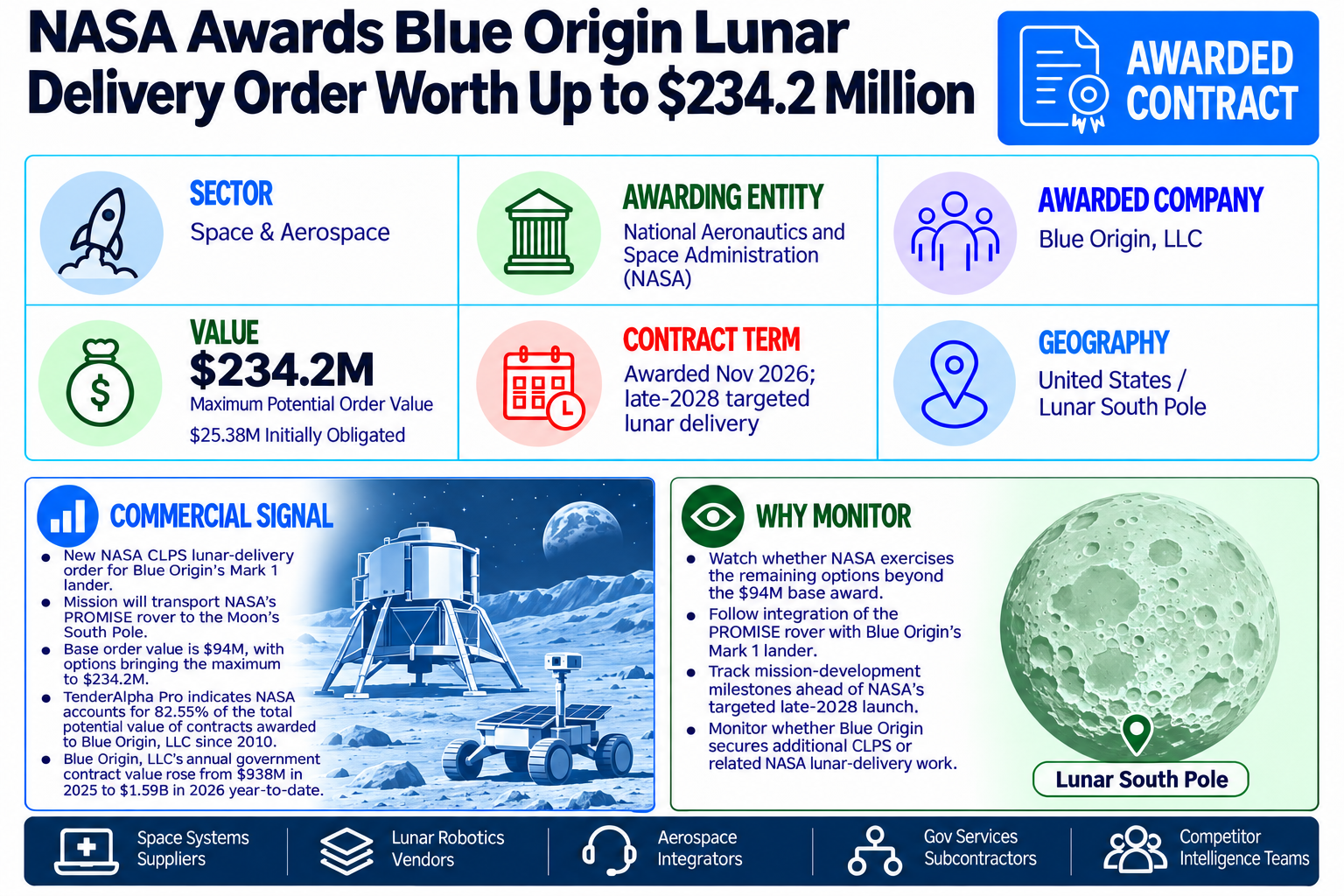
1. NASA Awards Blue Origin Lunar Delivery Order Worth Up to $234.2 Million
Buyer: National Aeronautics and Space Administration (NASA) | United States
Commercial Read
NASA awarded Blue Origin, LLC a new delivery order on 2 November 2026 under its Commercial Lunar Payload Services (CLPS) program. Blue Origin will use its Mark 1 lunar lander to transport NASA’s nuclear-powered PROMISE rover to the Moon’s South Pole, where it will investigate surface conditions and potential resources to support future exploration. NASA is targeting a late-2028 launch.
The order has a $94 million base value and approximately $140.2 million in potential options, bringing its maximum value to $234.2 million. Only $25.38 million was initially obligated. The remaining potential value is not guaranteed expenditure and depends on subsequent contractual decisions.
The award adds to a government contracting relationship heavily concentrated around NASA. According to TenderAlpha Pro, NASA accounts for 82.55% of the total potential value of government contracts awarded to Blue Origin, LLC since 2010 – approximately $3.15 billion out of $3.8 billion. This analysis covers Blue Origin, LLC specifically, rather than the entire Blue Origin corporate group.
TenderAlpha Pro data also shows a substantial increase in the annual total potential value of contracts awarded to Blue Origin, LLC in recent years. The figure stood at $510 million in 2023 and $502 million in 2024, before rising to $938 million in 2025 and reaching $1.59 billion in 2026 year-to-date, including the latest NASA order.
Blue Origin also featured in our 31 August-4 September G2B Sales Pulse, which examined NASA’s separate $660 million Mars telecommunications award.
Although the trajectory was not uniformly upward, the acceleration since 2024 is considerable. NASA’s dominant share of Blue Origin, LLC’s recorded government award value also underscores how much the entity’s future contracting activity may be shaped by the agency’s lunar exploration priorities. These figures measure potential contract values at award, not funds obligated or revenue recognized during each year.
What to Monitor Next
• Contract options: Whether NASA exercises the approximately $140 million performance-dependent option beyond the $94 million base award.
• Lunar mission preparations: Progress in integrating the PROMISE rover with Blue Origin’s Mark 1 lander ahead of NASA’s targeted late-2028 launch.
• Future NASA orders: Whether Blue Origin secures additional lunar-delivery assignments under NASA’s CLPS programs, which could further expand its recorded contract portfolio.
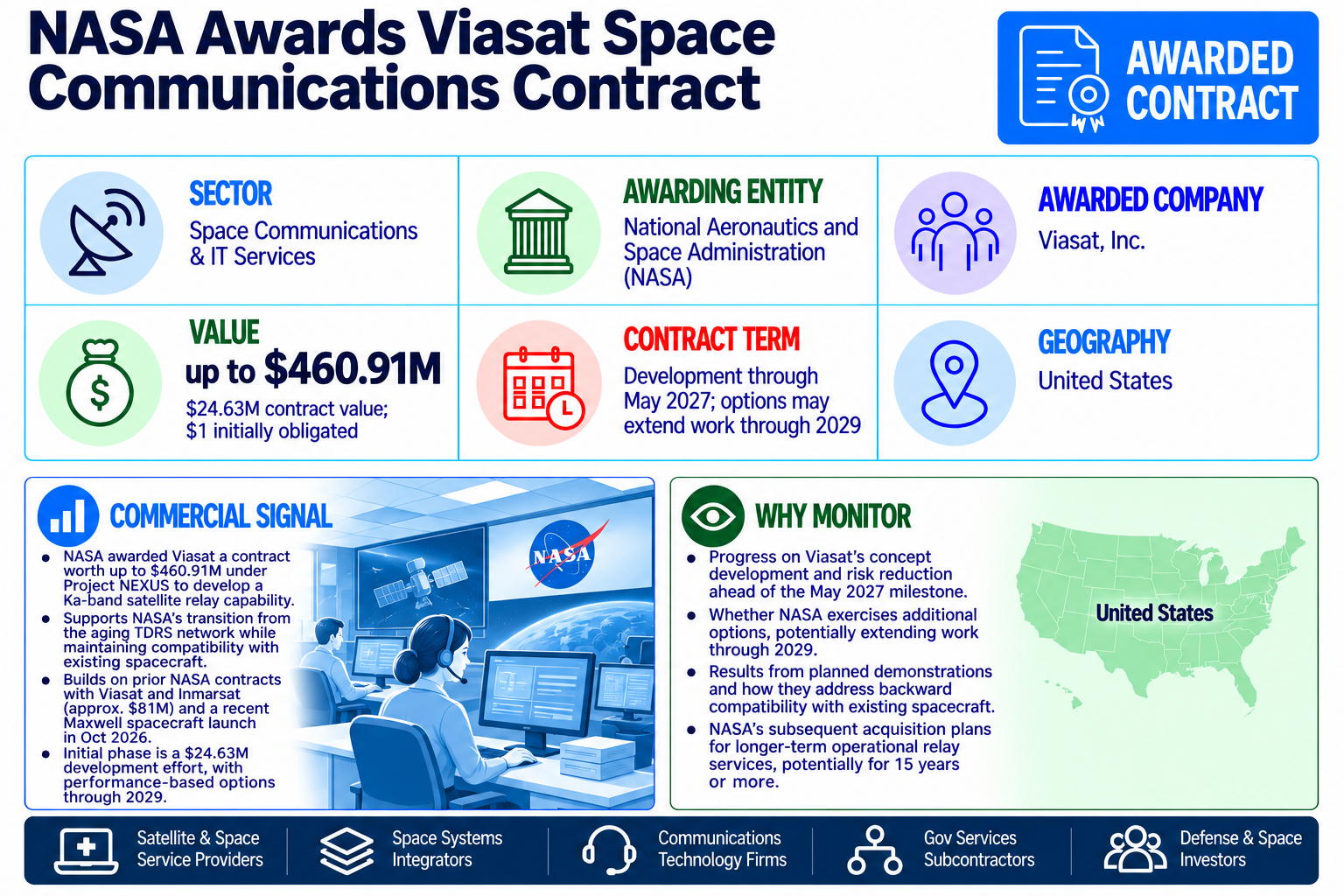
2. NASA Awards Viasat Space Communications Contract Worth Up to $460.9 Million
Buyer: National Aeronautics and Space Administration (NASA) | United States
Commercial Read
NASA awarded Viasat a contract on 4 November 2026 to develop a Ka-band satellite relay capability under Project NEXUS, part of the agency’s transition toward commercially provided space communications. Viasat received the largest maximum potential contract value among three selected companies, at $460.91 million, compared with $340.4 million for Global Enterprise Solutions and $264.3 million for Astranis Space Technologies.
The procurement addresses a specific challenge in NASA’s transition away from its aging Tracking and Data Relay Satellite (TDRS) network. Some spacecraft already in orbit cannot modify their communications hardware to accommodate newer commercial systems. Project NEXUS therefore seeks backward-compatible relay services that preserve connectivity for those missions while NASA gradually retires its existing infrastructure.
The intended capability extends beyond satellite bandwidth. NASA wants an end-to-end service incorporating space and ground infrastructure, launch, integration and operations. Its longer-term objective is to secure compatible services for at least 15 years, although the current award is a research and development contract rather than a 15-year operational service agreement.
Viasat is already participating in NASA’s commercial communications transition. Under earlier Communications Services Project agreements, Viasat and Inmarsat Government, which Viasat subsequently acquired, received awards totaling approximately $81 million. In October 2026, Viasat announced the successful launch of the Maxwell spacecraft carrying equipment for a separate NASA communications demonstration. In-orbit testing is scheduled to continue through March 2027.
That existing relationship gives Viasat relevant development and demonstration experience, but the new Project NEXUS award does not guarantee that it will become NASA’s future operational relay provider.
The contract’s financial structure reinforces that distinction. Its initial phase covers concept development and risk reduction through 3 May 2027, with priced options potentially extending work through 2029. Federal award records currently identify $24.63 million in contract value for the initial phase and just $1 in recorded initial obligations. The $460.91 million headline figure includes future options that NASA has not yet exercised.
NASA’s phased approach allows it to assess competing technical concepts and commercial viability before committing further funding. Viasat’s ability to demonstrate backward compatibility, alongside a commercially sustainable service model, will help determine how much of the contract’s potential value ultimately materializes.
What to Monitor Next
• Initial development phase: Viasat’s progress on concept maturation and technical risk reduction ahead of the 3 May 2027 milestone.
• Funding and demonstration decisions: Whether NASA exercises additional options and advances Viasat’s proposed capability toward an in-orbit demonstration, potentially extending work through 2029.
• Long-term service procurement: How NASA evaluates compatibility with existing spacecraft and whether the results influence its subsequent acquisition of operational relay services.
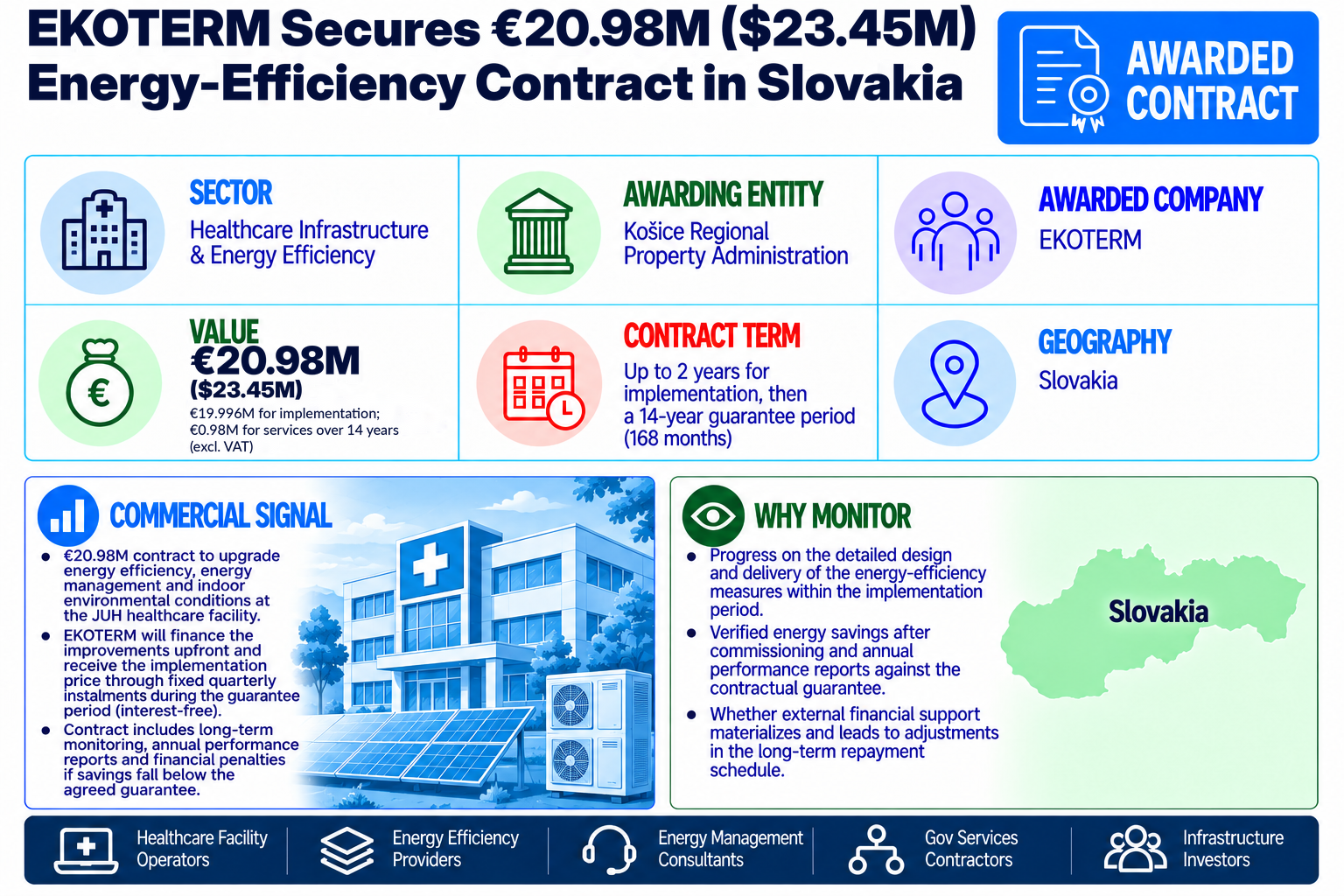
3. EKOTERM Secures €20.98 Million ($23.45 Million) Energy-Efficiency Contract for Slovak Healthcare Facility
Buyer: Košice Regional Property Administration | Slovakia
Commercial Read
Slovakia’s Košice Regional Property Administration signed a €20.98 million ($23.45 million) contract with EKOTERM on 3 November 2026 to improve energy efficiency, energy management and indoor environmental conditions at the JUH healthcare facility.
The project combines building and technical improvements with a long-term energy-performance guarantee. EKOTERM will prepare detailed technical specifications, implement the agreed measures and subsequently monitor energy consumption and the savings achieved.
The contract’s financial structure is particularly significant. Of the €20.98 million excluding VAT, approximately €20 million covers the implementation of the energy-efficiency measures, while €980,000 is allocated to associated services over a 14-year guarantee period.
Rather than receiving the full implementation payment upon completion, EKOTERM will finance the project and collect the agreed implementation price through fixed quarterly instalments during the subsequent guarantee period. The contract specifies that these deferred instalments are interest-free. Separate monthly service payments cover energy monitoring, performance evaluation and related activities.
The arrangement extends EKOTERM’s responsibilities well beyond construction. The agreement allows up to two years from its effective date for implementation, followed by a 14-year guarantee period beginning after the completed measures are accepted.
During that period, EKOTERM must monitor energy consumption, provide annual performance reports and demonstrate whether the agreed savings have been achieved. If actual savings fall below the contractual guarantee, the buyer can impose financial penalties calculated under the agreed methodology.
This creates a different commercial relationship from a conventional building refurbishment contract. EKOTERM assumes upfront financing requirements and continuing performance obligations, while the contracting authority spreads payments over an extended period and retains contractual protection against underperformance.
The project’s eventual financial outcome will therefore depend not only on successful installation but also on verified savings, continued equipment performance and the implementation of the long-term payment arrangement.
What to Monitor Next
• Technical design and implementation: Completion of the detailed technical specifications and delivery of the energy-efficiency measures within the contractual implementation period.
• Verified energy savings: The first performance assessments after commissioning, followed by annual reports measuring actual savings against the contractual guarantee.
• Project financing and payments: Whether anticipated external financial support materializes and leads to adjustments in the long-term repayment schedule.
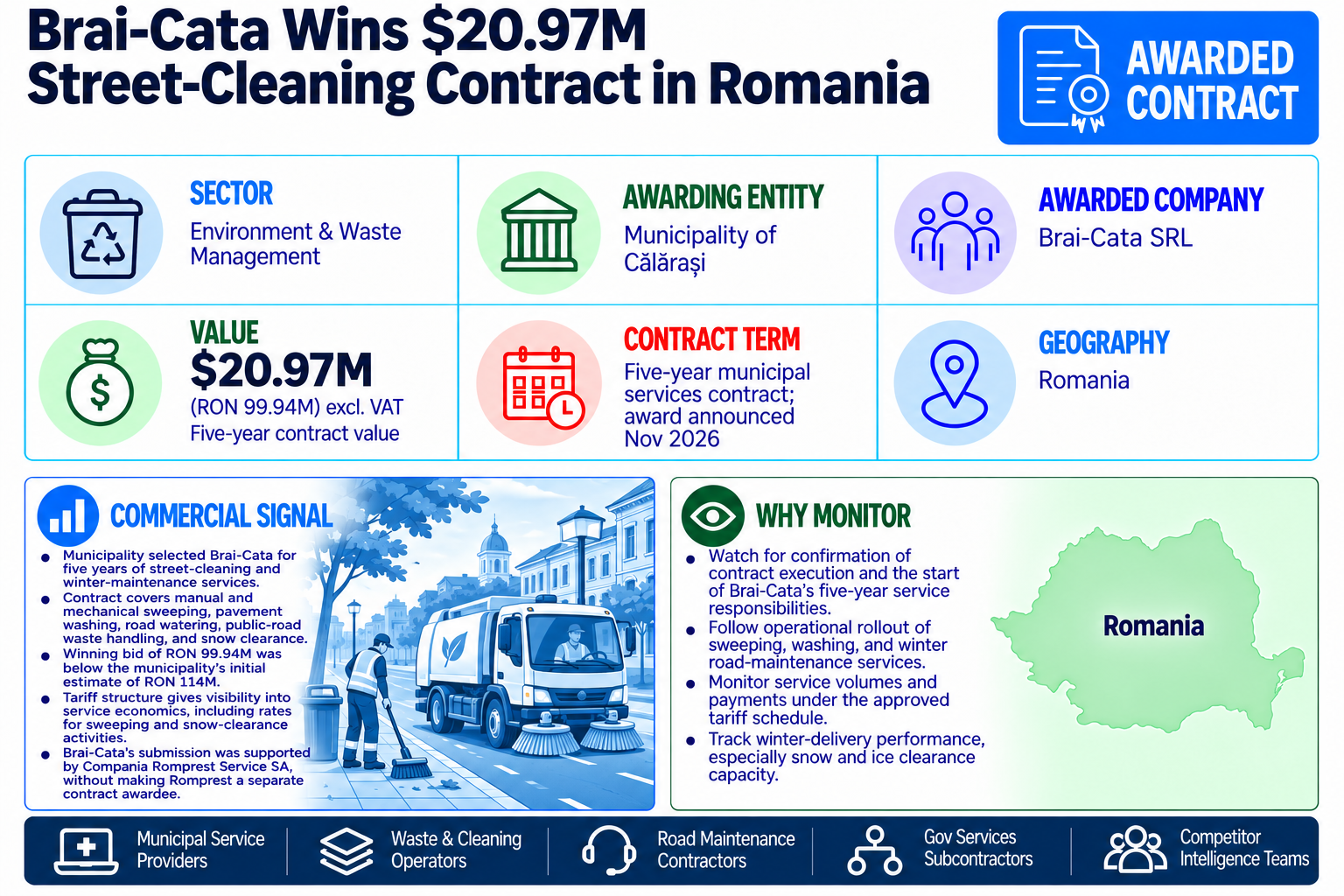
4. Brai-Cata Wins $20.97 Million Street-Cleaning Contract in Romania
Buyer: Municipality of Călărași | Romania
Commercial Read
Romania’s Municipality of Călărași selected Brai-Cata SRL to manage its public street-cleaning services under a five-year contract worth approximately $20.97 million (RON 99.94 million) excluding VAT. The municipality announced the outcome on 2 November 2026, following an open tender launched in May.
The winning offer is approximately 12.3% below the municipality’s initially stated estimate. Spread evenly across the five-year period, the award represents approximately $4.19 million annually, although actual payments will depend on the contract’s implementation and service delivery.
The contract covers manual and mechanical street sweeping, pavement washing, road watering and the collection and transportation of waste from public roads and street bins. It also includes winter maintenance, particularly snow clearance and maintaining road accessibility during icy conditions.
The municipality has approved a detailed tariff schedule for these activities. Mechanical sweeping of roads and pavements is priced at RON 8.47 per 1,000 square metres, while manual sweeping of pavements and walkways costs RON 31.20 per 1,000 square metres. Mechanical snow clearance carries a separate rate of RON 7.90 per 1,000 square metres. All three rates exclude VAT.
These service-specific tariffs provide a more detailed picture of the agreement than its overall five-year value. The eventual mix and volume of cleaning and winter-maintenance activities will be relevant to assessing how the contract translates into actual work and expenditure.
Brai-Cata’s bid was supported by Compania Romprest Service SA as a third-party supporting entity. That relationship formed part of the winning submission, but it does not establish Romprest as a separate direct contract recipient or confirm a subcontracting arrangement.
For Brai-Cata, the award establishes a substantial multiyear municipal services commitment. Its commercial significance will depend on the transition to service delivery, the operational requirements across different cleaning activities and the volume of work ultimately performed under the approved tariffs.
What to Monitor Next
• Contract execution and commencement: Confirmation of the signed agreement and the start of Brai-Cata’s five-year service responsibilities.
• Operational implementation: Deployment of sweeping, washing and road-maintenance services, particularly the capacity to deliver snow and ice clearance during winter.
• Service volumes and expenditure: Reported activity levels and payments under the approved tariffs, showing how actual expenditure develops against the $20.97 million contract value.
5. Essex County Council Selects Matrix SCM for £48 Million ($64.66 Million) Temporary Worker Support Contract
Buyer: Essex County Council | United Kingdom
Commercial Read
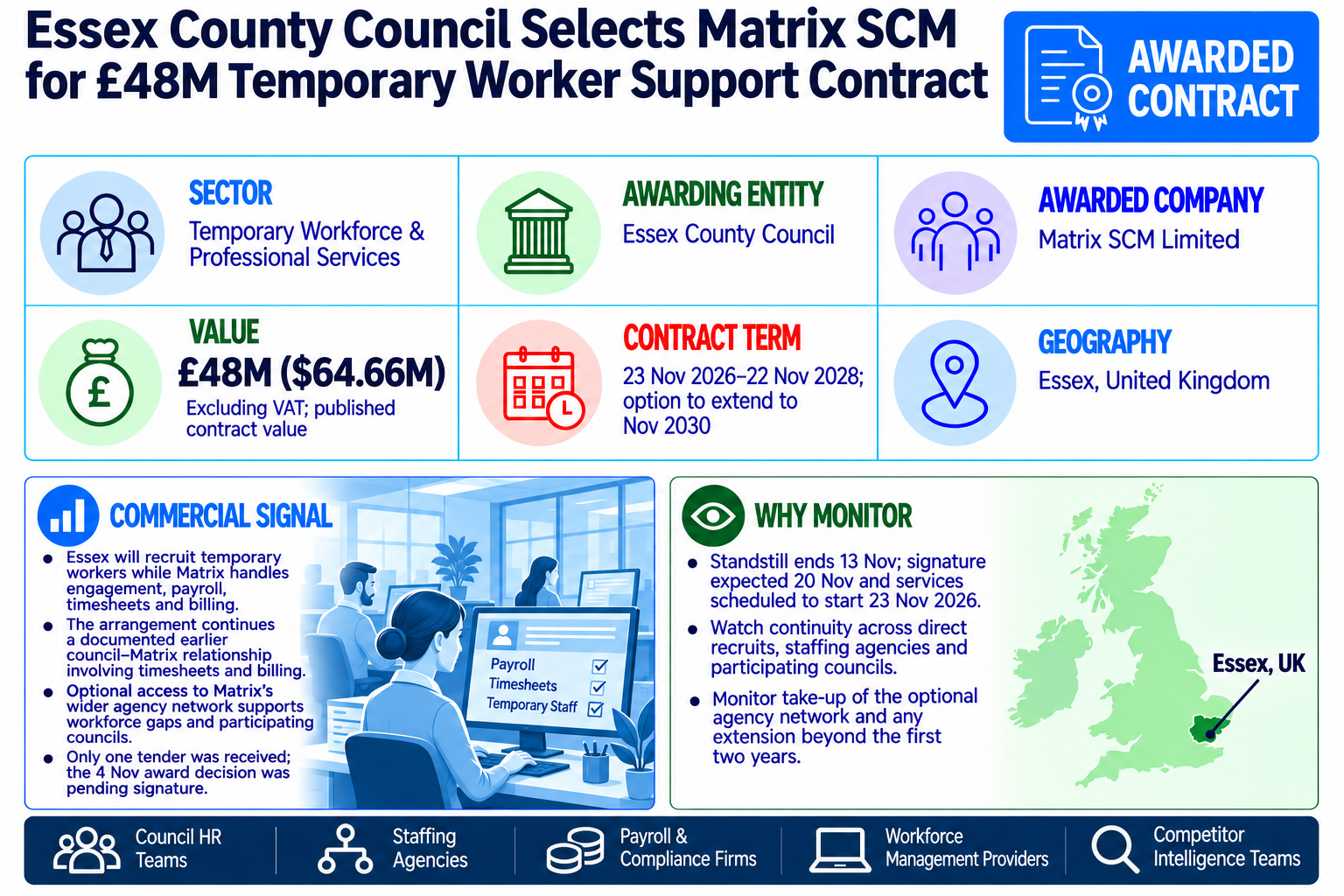
Essex County Council selected Matrix SCM Limited on 4 November 2026 for a temporary worker support services contract valued at £48 million ($64.66 million) excluding VAT. The initial two-year agreement is scheduled to begin on 23 November 2026, with an option to extend services for a further two years until November 2030.
The contract covers a central administrative function within the council’s temporary workforce arrangements. Essex will continue to manage recruitment and candidate attraction through its HR Shared Services Team, while Matrix will handle contractual engagement, weekly payroll, timesheet processing and billing for temporary workers recruited directly by the council or supplied through third-party agencies.
The arrangement also covers existing and future local authority partners using Essex’s workforce services. Matrix must provide optional access to its wider agency supply chain, potentially through a neutral-vendor network, when the council requires additional recruitment support or alternative routes to filling vacancies.
The council’s approach separates recruitment decisions from workforce administration. While Essex retains control over sourcing candidates, Matrix provides the infrastructure needed to manage worker engagement, payroll and billing across multiple recruitment channels. The latest award preserves that division of responsibilities and provides for contingency access to additional staffing suppliers.
The £48 million figure represents the published contract value rather than guaranteed revenue or profit for Matrix. The notice does not provide sufficient detail to distinguish the supplier’s administrative fees from any associated workforce expenditure.
The award was still awaiting contract signature when announced, with a standstill period ending on 13 November and signature expected on 20 November. The commercial significance of the agreement will depend on the continuation of existing workforce services, successful delivery across participating authorities and the extent to which the council uses Matrix’s optional agency network.
What to Monitor Next
• Contract signature and commencement: Completion of the standstill period on 13 November, the expected contract signature on 20 November and the scheduled start of services on 23 November 2026.
• Service continuity: How Matrix implements the new agreement across Essex’s directly recruited workforce, third-party agencies and participating local authorities.
• Additional staffing arrangements: Whether Essex uses Matrix’s optional agency network to fill recruitment gaps or extends the service to additional local authority partners.
Open Tenders
1. Dutch Defence Seeks Supplier for €70.8 Million ($79.09 Million) Beverage Services Framework
Contracting authority: Ministry of Agriculture, Fisheries, Food Security and Nature | Netherlands
Beneficiary: Ministry of Defence
Commercial Read
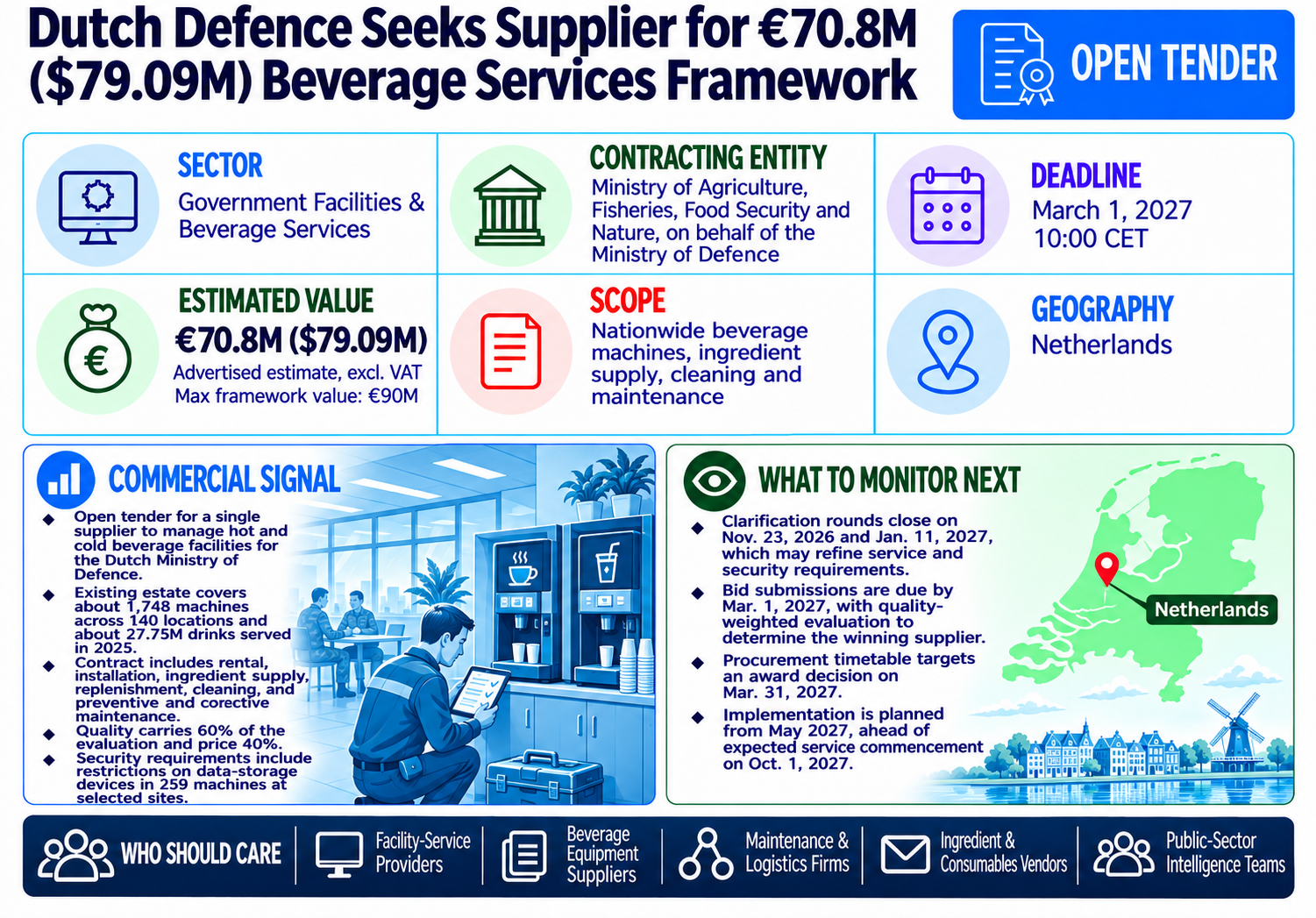
The Ministry of Agriculture, Fisheries, Food Security and Nature is conducting a procurement for hot and cold beverage facilities at Ministry of Defence locations under a framework agreement with an advertised estimated value of €70.8 million ($79.09 million) excluding VAT. The open tender, published on 30 October 2026, closes on 1 March 2027 at 10:00 CET.
The contract covers the rental and installation of beverage machines, ingredient supply, daily replenishment and cleaning, and preventive and corrective maintenance. Drinks will be provided free of charge to users, with the selected contractor responsible for keeping equipment operational across a geographically dispersed network.
The scale of the existing operation is substantial. Defence currently has approximately 1,748 machines across 140 locations, including military bases, training facilities, offices and operational sites. The tender documents record approximately 27.75 million drink servings in 2025, excluding cold water.
Delivering a consistent service across these locations presents logistical and technical challenges. Some facilities operate around the clock, while others have relatively small workforces or additional security requirements. The contractor must accommodate different usage patterns, maintain stock availability and respond to equipment faults without disrupting operations.
Security is a particularly distinctive element. The tender identifies 259 existing machines that must not contain data-storage devices, with the precise requirements to be finalized during implementation. The supplier must also comply with the Dutch government’s security requirements for sensitive public contracts, including the applicable ABRO screening regime.
The procurement is structured as a single nationwide contract rather than separate geographic lots. The initial six-year term can be extended through two one-year options, with services expected to begin on 1 October 2027. The buyer justifies the longer duration partly through the economic life and depreciation period of the equipment.
There is an important distinction between the procurement’s advertised value and its contractual spending limit. While the published notice estimates €70.8 million excluding VAT, the detailed procurement document gives an estimate of €69.5 million and sets a maximum framework value of €90 million, including extension years. The buyer explicitly acknowledges that actual demand could be substantially lower than forecast.
The evaluation places greater weight on quality than price, at 60% and 40%, respectively. Together with the security requirements and nationwide operating model, this makes the procurement more than a competition to supply coffee machines. The successful bidder will need to demonstrate the ability to finance and maintain equipment, manage a substantial servicing network and provide reliable delivery under the operational constraints of defence facilities.
What to Monitor Next
• Clarifications and security requirements: The first clarification round closes on 23 November 2026, followed by a second on 11 January 2027. Responses may clarify equipment restrictions, service obligations and bidder compliance requirements.
• Tender submissions and evaluation: Bids are due by 10:00 CET on 1 March 2027. The quality-weighted evaluation will determine which supplier is best positioned to secure the nationwide framework.
• Award and service transition: The procurement timetable targets an award decision on 31 March 2027, with implementation planned from May ahead of the scheduled 1 October service commencement. The transition from the existing agreement will be an important early delivery milestone.
2. Priory Federation Seeks School-Cleaning Provider Under £6 Million ($8.09 Million) Tender
Contracting authority: The Priory Federation of Academies Trust | United Kingdom
Commercial Read
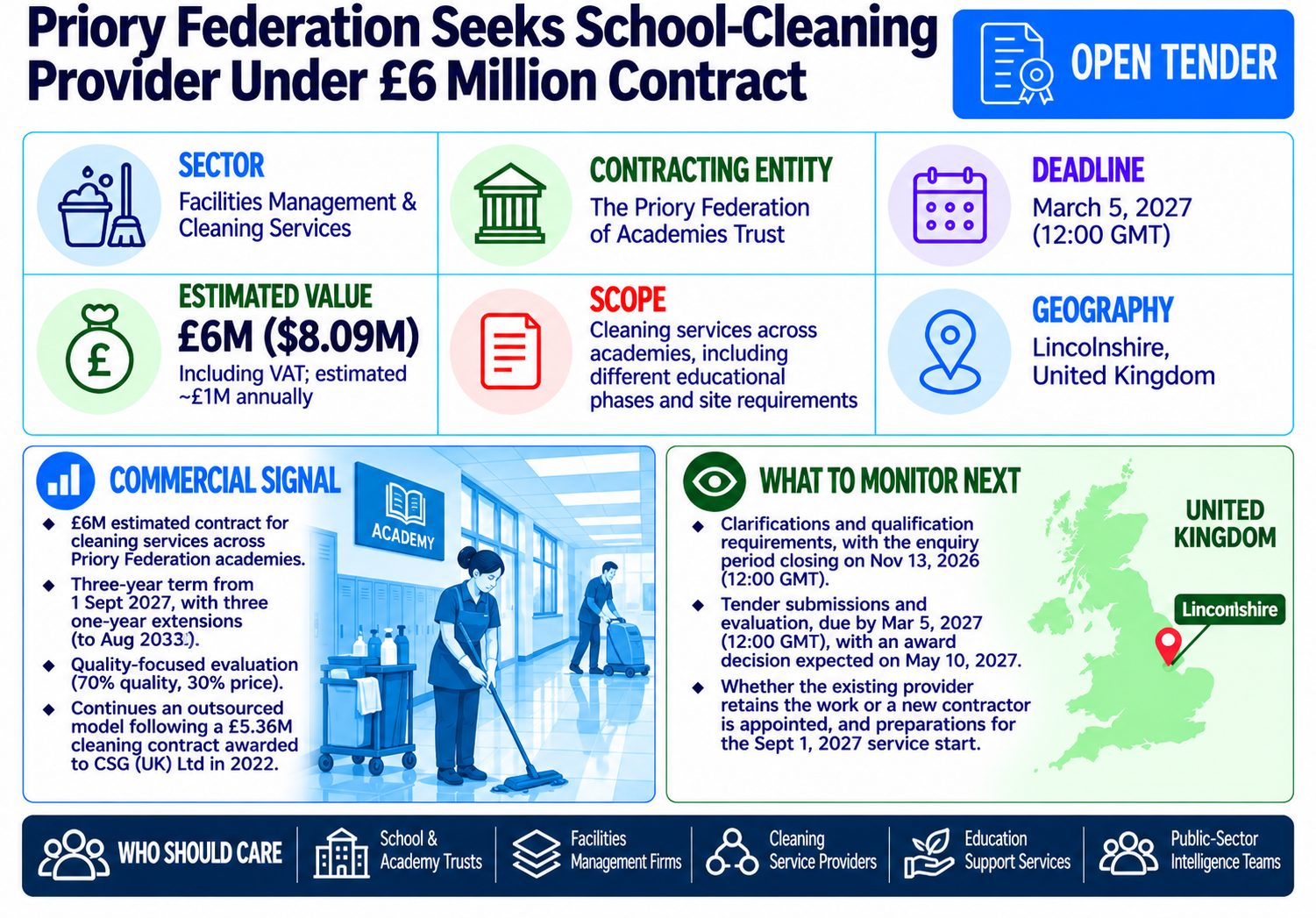
The Priory Federation of Academies Trust is seeking a supplier to deliver cleaning services across its academies in Lincolnshire, England, under a contract with an estimated value of £6 million ($8.09 million) including VAT. Published on 14 September 2026, the tender invites submissions until 5 March 2027 at 12:00 GMT.
The agreement is expected to begin on 1 September 2027 and run for an initial three years, with three optional one-year extensions potentially taking the contract through August 2033. The tender description estimates the service at approximately £1 million annually, although it does not specify the VAT treatment of that annual figure. The £6 million headline amount is an estimated procurement value, not guaranteed expenditure.
The Trust operates academies with different educational phases, staffing profiles, enrolment levels and operating environments. Its procurement therefore involves coordinating cleaning services across institutions with potentially different requirements rather than delivering a uniform service at a single location.
The tender continues an established outsourcing arrangement. In August 2022, the Priory Federation awarded CSG (UK) Ltd a building-cleaning contract covering 11 academies, with a reported value of £5.36 million excluding VAT. That agreement had an initial three-year term with two optional one-year extensions.
The earlier award establishes that cleaning services were already outsourced, although it does not confirm whether CSG remains the incumbent supplier or whether the new procurement covers precisely the same sites. The two published contract values also have different VAT classifications and potential durations, preventing a straightforward comparison of expenditure.
The new procurement places considerable emphasis on service quality. Technical and quality considerations account for 70% of the evaluation, compared with 30% for price. This weighting gives bidders substantial scope to differentiate their proposals through the quality of their operating arrangements rather than competing primarily on cost.
The competition follows a competitive flexible procedure, with the notice referring suppliers to a pre-selection questionnaire for further information. Detailed qualification conditions and any additional procedural requirements must be checked through the procurement portal.
For prospective suppliers, the commercial challenge lies in demonstrating how they would manage cleaning services across institutions with different operational needs while maintaining consistent delivery standards. The eventual award will also determine whether the Trust continues with an established provider or transitions to a new contractor before the September 2027 academic year.
What to Monitor Next
• Clarifications and qualification requirements: The enquiry period closes on 13 November 2026 at 12:00 GMT. Any further information about individual academies, service requirements and the pre-selection process could affect supplier preparation.
• Tender submissions and evaluation: Responses are due on 5 March 2027 at 12:00 GMT. The 70% quality weighting makes the assessment of service proposals particularly important, with an award decision currently expected on 10 May 2027.
• Supplier selection and transition: Whether the existing provider retains the work or a new contractor is appointed, and how the successful supplier prepares for the scheduled 1 September 2027 service commencement.
3. Canary Islands Health Service Maintains €4.33 Million ($5.09 Million) Works-Supervision Procurement Category
Contracting authority: Directorate-General for Economic Resources, Canary Islands Health Service | Spain
Commercial Read
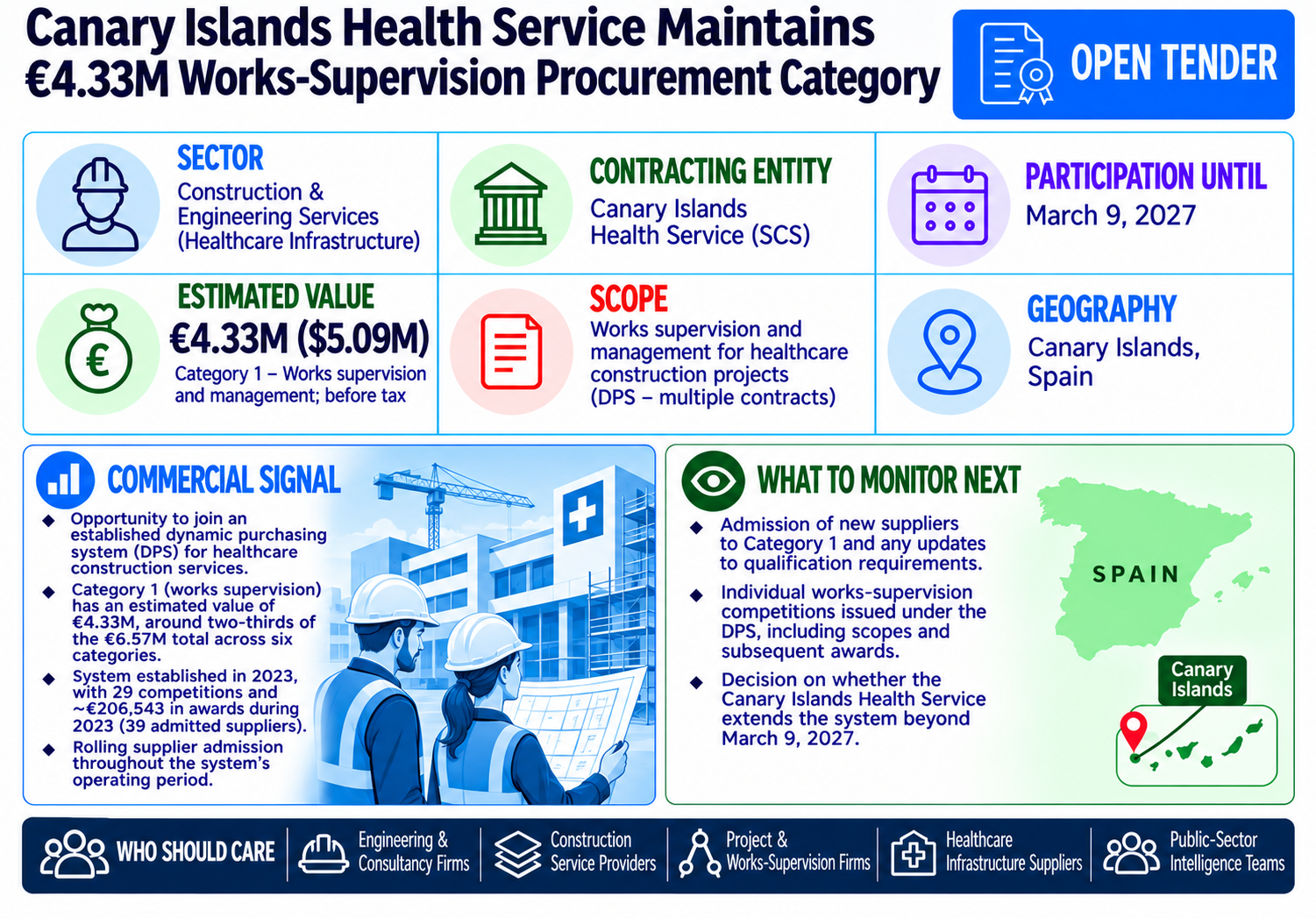
The Canary Islands Health Service (SCS) is maintaining access to a dynamic purchasing system for technical services associated with healthcare construction projects, with its current operating period scheduled to end on 9 March 2027. The system includes a works-supervision category with an estimated value of €4.33 million ($5.09 million) before tax.
Unlike a conventional tender for a specific project, this procurement allows qualified firms to join an established pool of suppliers and compete for individual assignments as the health service’s requirements arise. The €4.33 million figure represents the estimated value of Category 1, covering works supervision and management, rather than the budget for a single contract.
The purchasing system was established in March 2023 and covers six categories of technical services. Alongside works supervision, these include architectural and engineering project drafting, health and safety coordination, construction quality control, topographical surveys and geotechnical studies.
The overall estimated value across all six categories is approximately €6.57 million before tax. Works supervision accounts for roughly two-thirds of that amount, making it the largest category by published estimated value.
The structure differs significantly from a framework agreement with a fixed group of suppliers. Under Spain’s rules for dynamic purchasing systems, companies meeting the relevant qualification requirements can apply for admission throughout the system’s operating period. The number of admitted suppliers is not capped.
Once admitted to the relevant category, companies become eligible to compete for specific contracts issued through the system. Admission itself does not guarantee an award or any particular volume of work.
For participating firms, the commercial significance lies in gaining access to a recurring procurement channel rather than competing for one large contract. Individual assignments may differ in technical scope, location, duration and value, allowing the health service to obtain specialized expertise as construction requirements emerge.
The system’s current authorization through March 2027 also makes its next renewal decision important. Continued operation would preserve this procurement route, while future individual competitions will determine how much of the estimated category value translates into actual contract awards.
What to Monitor Next
• Supplier admission: Decisions on applications from new companies seeking qualification for Category 1, including any updated technical or financial eligibility requirements.
• Individual contract opportunities: New works-supervision competitions issued to admitted suppliers, together with their specific project scopes, evaluation requirements and subsequent awards.
• System renewal: Whether the Canary Islands Health Service authorizes another extension before the currently published 9 March 2027 end date, allowing further participation and procurement activity.
Conclusion
The latest G2B Sales Pulse highlights how government contracting activity can reveal more than the value of individual awards. NASA’s growing commitments to commercial space capabilities, the long-term financial and operational obligations attached to European service contracts, and the differing participation structures of open tenders all demonstrate why contract terms matter alongside headline figures.
Blue Origin’s contracting history is particularly revealing. TenderAlpha Pro data shows the extent of NASA’s role in Blue Origin, LLC’s government award portfolio, while the company’s recent growth in total potential contract values provides a broader perspective on its latest lunar-delivery order.
Explore government contracting activity, historical buyer–supplier relationships and contract-value trends in greater detail with TenderAlpha Pro.
Request a TenderAlpha Pro demo to learn more.