
Key Points:
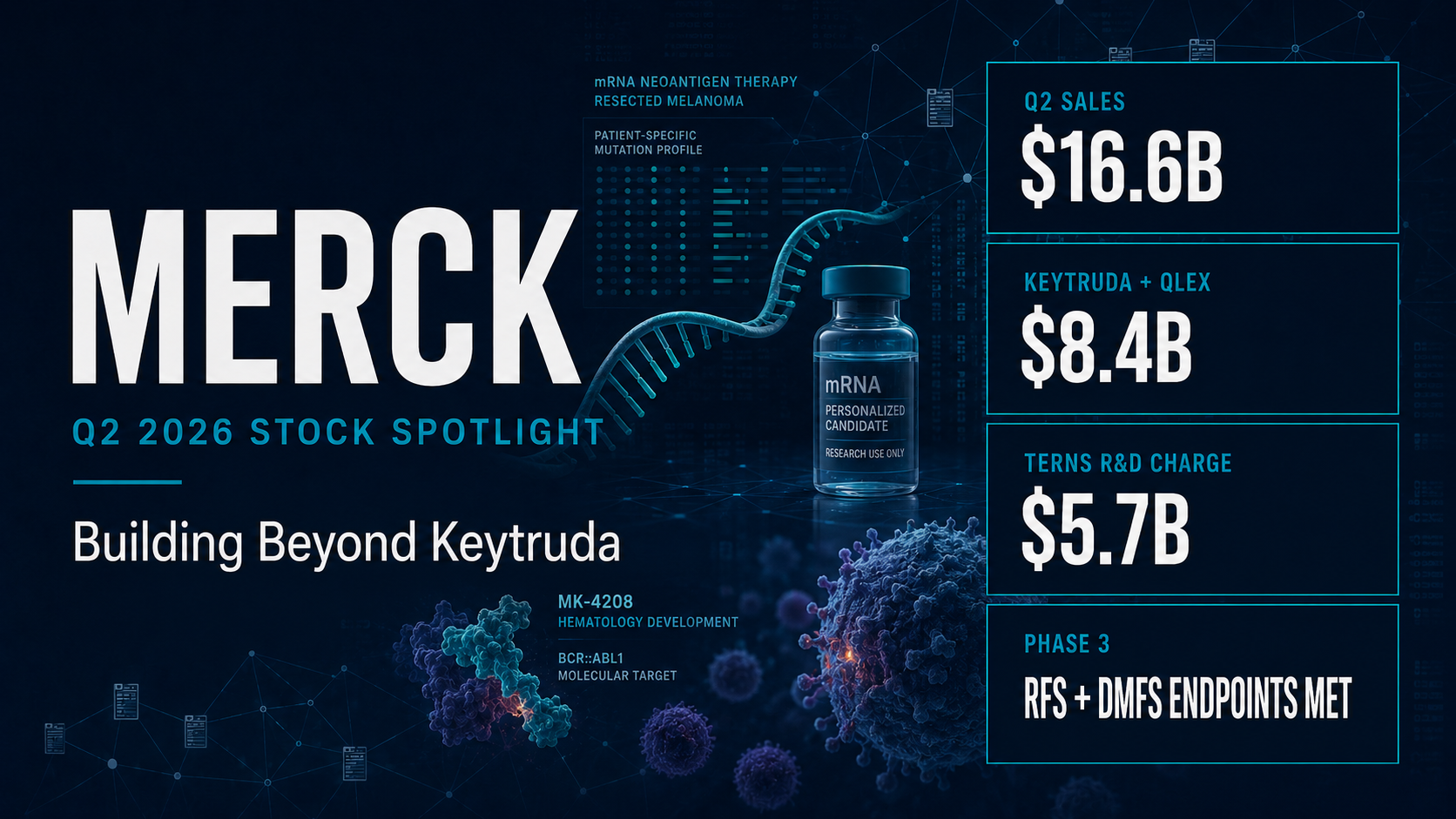
- Merck’s Q2 2026 sales rose 5% to $16.6 billion. Keytruda and Keytruda Qlex generated $8.4 billion, while Animal Health sales increased 8% to $1.8 billion.
- The Terns acquisition added MK-4208, formerly TERN-701, to Merck’s hematology pipeline. A $5.7 billion one-time R&D charge drove the quarterly loss and contributed to lower 2026 non-GAAP EPS guidance.
- Intismeran autogene plus Keytruda met the Phase 3 recurrence-free and distant metastasis-free survival endpoints in resected melanoma. Detailed results, overall-survival follow-up and regulatory review will determine the next stage of the program.
- TenderAlpha trade flows data maps activity across Merck affiliates and external counterparties, while HS classifications add product-category detail. Government contract awards data provides supplementary insight into public-sector buyers and procurement structures, including pharmaceutical frameworks in Italy and a vaccine supply agreement in Australia.
Q2 Sales Growth Was Overshadowed by the Terns Charge
Merck reported worldwide sales of $16.61 billion in Q2 2026, an increase of 5% from the prior-year period and 4% excluding foreign-exchange effects. Pharmaceutical sales rose 5% to $14.76 billion and represented approximately 89% of group sales. Animal Health contributed $1.78 billion, an increase of 8%.
Keytruda and the subcutaneous formulation Keytruda Qlex remained central to the company’s performance, producing $8.37 billion of quarterly sales. That was just over half of Merck’s total revenue, underscoring both the product’s continuing strength and the importance of developing additional growth drivers before Keytruda’s principal patent protections begin to expire later in the decade.
Table 1: Merck Q2 2026 financial highlights
| Metric | Q2 2026 | Q2 2025 | Change |
|---|---|---|---|
| Sales | $16.61bn | $15.81bn | +5% |
| Non-GAAP gross margin | 81.1% | 82.2% | -1.1 percentage points |
| Non-GAAP operating expenses | $12.6bn | $6.6bn | +91% |
| Non-GAAP effective tax rate | 160.3% | 15.0% | Not meaningful |
| Non-GAAP (loss)/EPS | $(0.13) | $2.13 | Not meaningful |
Non-GAAP gross margin declined by 1.1 percentage points to 81.1%, primarily because of higher inventory write-downs. The much larger change occurred in operating expenses. Non-GAAP operating expenses rose 91% to $12.6 billion, mainly because R&D included the $5.7 billion Terns acquisition charge and higher clinical-development spending. Selling, general and administrative expenses also increased, reflecting administrative and IT investment as well as promotional spending for product launches.
The acquisition closed in May 2026 and made Terns a wholly owned Merck subsidiary. Its principal asset, MK-4208, is an investigational oral allosteric BCR::ABL1 inhibitor in Phase 1/2 development for certain patients with chronic myeloid leukemia. The acquisition therefore expands Merck’s hematology pipeline rather than adding immediate product sales. Its near-term financial effect is chiefly the acquisition-related R&D charge and associated financing and development costs.
Table 2: Merck updated 2026 guidance
| Metric | Prior guidance | Updated guidance |
|---|---|---|
| Worldwide sales | $65.8bn-$67.0bn | $66.3bn-$67.3bn |
| Non-GAAP gross margin | Approximately 82.0% | Approximately 81.0% |
| Non-GAAP operating expenses | $36.0bn-$36.8bn | $42.0bn-$42.7bn |
| Other income/(expense) | Approx. $1.3bn expense | Approx. $1.4bn expense |
| Non-GAAP tax rate | Approx. 23.5%-24.5% | Approx. 35.0%-36.0% |
| Non-GAAP EPS | $5.04-$5.16 | $2.66-$2.76 |
Merck raised and narrowed its sales outlook to $66.3-$67.3 billion but reduced expected non-GAAP EPS to $2.66-$2.76. The EPS reduction largely reflects one-time business-development charges, including Terns, rather than a comparable deterioration in product demand. The distinction is important when assessing the quarter: Merck’s reported profitability was heavily affected by pipeline investment, while sales continued to grow.
A Phase 3 Melanoma Milestone Strengthens the Post-Keytruda Pipeline
On August 19, Merck and Moderna announced positive topline results from INTerpath-001, a Phase 3 study of intismeran autogene plus Keytruda in patients with completely resected stage IIB-IV melanoma. The combination met the primary endpoint of recurrence-free survival and the key secondary endpoint of distant metastasis-free survival compared with Keytruda alone.
Intismeran is an individualized mRNA-based neoantigen therapy designed using the mutations identified in a patient’s tumor. Merck and Moderna plan to present detailed Phase 3 results and discuss filing submissions with regulators. Overall survival continues to be evaluated, so the announcement is a significant clinical milestone rather than a completed regulatory or commercial outcome.
The companies are studying intismeran across nine Phase 2 and Phase 3 trials involving melanoma, non-small cell lung cancer, bladder cancer and renal cell carcinoma. The positive melanoma result supports the broader development strategy, but efficacy in other tumor types must be established separately.
The $70 Billion Opportunity Is a Pipeline Measure, Not a Revenue Forecast
Merck describes more than $70 billion in potential annual sales from current and prospective new growth drivers by the mid-2030s. This is a non-risk-adjusted opportunity estimate, not a forecast for Merck’s consolidated revenue. A successful Phase 3 study can help de-risk an individual program within that portfolio, but it does not by itself increase the aggregate opportunity or establish how much revenue the product will generate.
The more useful question for investors is how rapidly Merck can convert clinical progress into approved products capable of diversifying the business beyond Keytruda. Detailed INTerpath-001 data, regulatory timing, manufacturing requirements for an individualized therapy and the economics of Merck’s collaboration with Moderna will all influence the program’s eventual contribution.
Trade Flows Map Merck’s Affiliates and External Counterparties
Merck’s consolidated financial statements show where revenue and expense are recognized, but they provide limited visibility into many of the individual companies participating in the operating network. TenderAlpha trade flows data adds that relationship layer by identifying the buyer and supplier associated with observed shipments and linking subsidiaries to their wider corporate groups.
This distinction is particularly useful for Merck, which operates as MSD outside the United States and Canada and conducts activity through numerous subsidiaries. TenderAlpha’s entity resolution connects records involving Merck, MSD entities and animal-health subsidiary Intervet while retaining visibility into the specific legal entity recorded as buyer or supplier. Users can therefore distinguish affiliated flows from activity involving external suppliers and distributors rather than treating every named counterparty as an independent customer.
Table 3: Selected Merck company relationships and recorded flow patterns, 2019-August 2026
| Counterparty | Observed pattern | Relationship context |
|---|---|---|
| Intervet International B.V. | Affiliated/intercompany activity | Merck animal-health subsidiary; records include medicine and vaccine categories |
| Almac Clinical Services | Primarily inbound activity | External clinical-supply, manufacturing, packaging and logistics organization |
| Fisher Clinical Services | Primarily inbound activity | Thermo Fisher Scientific subsidiary providing clinical-supply and logistics capabilities |
| McKesson | Primarily outbound activity | External pharmaceutical distribution counterparty |
| Cardinal Health | Primarily outbound activity | External pharmaceutical distribution counterparty |
| Alexandria Real Estate Equities | Publicly disclosed relationship | Long-term real estate relationship supporting Merck’s South San Francisco research facility |
HS Codes Add a Product Layer
The relationship map becomes more informative when shipment direction is combined with product classification. Harmonized System codes provide an internationally standardized way to classify traded products. In Merck-related records, those classifications and shipment descriptions help distinguish broad categories such as medicines, vaccines and other pharmaceutical products.
For an investor, corporate strategy team or private-markets researcher, this makes it possible to examine more than the existence of a relationship. Users can compare whether activity is predominantly inbound or outbound, which product categories are involved, where the shipments originate and end, and how recorded value and frequency change over time. The evidence can help surface shifts in product mix, geographic exposure, counterparty concentration and relationship intensity that may merit further investigation alongside financial and operational disclosures.
Applied consistently across affiliates, suppliers and distributors, HS classifications turn a list of company names into a structured product view of Merck’s network. Users can compare categories across counterparties and track how the composition of recorded trade activity changes over time.
Government Records Show Higher 2026 Value but a Supplementary Business Channel
Merck’s government-contracting history remains heavily influenced by pandemic-era purchasing. TenderAlpha recorded $5.81 billion in associated award value during 2021, followed by lower annual totals as exceptional COVID-19 procurement receded. Recorded value reached $1.10 billion in 2025 and $1.25 billion during 2026 through August.
Table 4: Merck government-contracting activity, 2021-August 2026
| Year | Recorded award value (USD) | Contract records |
|---|---|---|
| 2026 YTD | $1,246,080,811 | 928 |
| 2025 | $1,100,791,041 | 1,686 |
| 2024 | $1,264,172,746 | 1,683 |
| 2023 | $2,452,809,083 | 440 |
| 2022 | $2,551,428,230 | 613 |
| 2021 | $5,809,598,122 | 655 |
The 2026 year-to-date value is approximately 13% higher than the amount recorded for the whole of 2025. This is a measurable increase in public-sector activity, but it does not indicate that government contracting has become a material driver of Merck’s overall business. Its analytical value lies in showing which public buyers, jurisdictions and procurement programs contribute to the recorded total.
The number of contract records adds another dimension. Records increased from 440 in 2023 to 1,683 in 2024 even as aggregate award value declined. Pharmaceutical procurement frameworks can cover numerous products and lots, and the related TenderAlpha records may reflect different elements of a wider procurement structure. This provides context for why record counts and annual award values do not necessarily move in parallel. Read together, the two measures provide different views of the breadth and financial scale of Merck’s recorded government-contracting activity.
What the Italy and Australia Records Show
TenderAlpha records connect MSD Italia with a Ligurian regional pharmaceutical procurement covering 2,595 lots. The multi-lot structure provides context for the higher number of contract records from 2024 onward, while TenderAlpha’s entity resolution connects subsidiary-level awards to Merck’s wider government-contracting profile.
TenderAlpha also identifies a Merck Sharp & Dohme Australia agreement to supply essential vaccines to the National Immunisation Program, with recorded value reaching approximately A$52 million after the agreement was expanded. Together, the Italian and Australian records allow users to move from aggregate annual totals to the public buyers, Merck entities and procurement programs behind the figures.
Conclusion
Merck’s Q2 2026 results combined 5% sales growth with a large Terns-related charge and a strengthened post-Keytruda pipeline. The acquisition added an early-stage chronic myeloid leukemia candidate, while the positive Phase 3 melanoma result provides a more advanced milestone, subject to detailed data and regulatory review.
TenderAlpha complements this picture by mapping Merck’s affiliates, external counterparties, HS-classified product flows and public-sector buyers. Together, trade flows data and government contracts data help users monitor changes in product mix, geography, relationship intensity and procurement activity beyond Merck’s consolidated disclosures.
Explore Merck’s company relationships, shipment classifications and government contract awards data in TenderAlpha Pro. Request a TenderAlpha Pro demo
This article is provided for informational purposes only and does not constitute investment advice, a recommendation to buy or sell securities, or an assessment of the suitability of any investment. Readers should conduct their own research and consult an appropriate professional adviser before making investment decisions.