

Key Points
- Cisco Systems delivered 12% revenue growth in fiscal 2026, including an 18% increase in Q4. The midpoint of its fiscal 2027 guidance points to another roughly 15% increase in annual revenue.
- AI infrastructure is becoming a much larger part of the business. Cisco recorded $9.3 billion of hyperscaler AI infrastructure orders in fiscal 2026 and expects related revenue to rise from about $4 billion in fiscal 2026 to around $7.5 billion in fiscal 2027.
- The expansion is putting more weight on Cisco’s manufacturing and component network. Purchase commitments with contract manufacturers and suppliers more than doubled to $17.2 billion at the end of fiscal 2026.
- Government award activity has also picked up in 2026. A recent Department of Defense notice for a potential DoD-wide Cisco enterprise agreement points to a strategically important public-sector opportunity still moving through the procurement process.
Cisco Enters Fiscal 2027 With Stronger AI Infrastructure Momentum
Cisco Systems (NASDAQ: CSCO) ended fiscal 2026 with its strongest annual revenue growth in more than a decade.
Revenue rose 12% to $63.3 billion for the fiscal year and 18% year over year to $17.3 billion in Q4. Product revenue increased 24% in the final quarter, led by 28% growth in Networking and 14% growth in Security.
Table 1: Cisco Systems Q4 and Fiscal 2026 Revenue by Product Category
| Revenue category | Q4 FY2026 ($m) | Y/Y | FY2026 ($m) | Y/Y |
|---|---|---|---|---|
| Networking | 9,791 | 28% | 34,668 | 22% |
| Security | 2,226 | 14% | 8,232 | 2% |
| Collaboration | 1,167 | 12% | 4,300 | 4% |
| Observability | 275 | 6% | 1,095 | 4% |
| Total Product | 13,459 | 24% | 48,295 | 16% |
| Services | 3,793 | — | 15,030 | — |
| Total | 17,252 | 18% | 63,325 | 12% |
Source: Cisco Systems Q4 and fiscal 2026 earnings release.
AI infrastructure is taking a larger role in that growth. Cisco reported $4 billion of hyperscaler AI infrastructure orders in Q4 alone, bringing the fiscal-year total to $9.3 billion. The company generated about $4 billion of AI infrastructure revenue in fiscal 2026 and expects that figure to reach roughly $7.5 billion in fiscal 2027.
Management is guiding for total fiscal 2027 revenue of $72.2–$73.4 billion. At the midpoint, that would mean growth of about 15%. Non-GAAP EPS is expected at $5.05–$5.11, compared with $4.33 in fiscal 2026.
The scale-up is already visible beyond the income statement.
AI Growth Is Putting More Weight on Cisco’s Supply Chain
Cisco finished fiscal 2026 with $17.165 billion of inventory purchase commitments with contract manufacturers and suppliers, up from $7.599 billion a year earlier. That is a 126% increase.
Cisco linked much of the rise to commitments for manufacturing Cisco Silicon One and other products needed to meet hyperscaler and broader customer demand. Memory pricing and commitments to secure memory and other components also contributed.
TenderAlpha’s trade flows data add another view of the operating network behind that expansion.
The records show activity involving semiconductor and electronics entities in Asia, logistics operations in Mexico, and established Cisco distribution relationships in Latin America and Southeast Asia.
Table 2: Selected Cisco Systems Company Relationships and Recorded Trade Flows Patterns, 2019–2026
| Counterparty | Recorded flow pattern | Relationship context |
|---|---|---|
| Micron Memory Malaysia | Primarily inbound activity | Malaysian subsidiary of Micron Technology |
| Flextronics Technologies (India) | Inbound and outbound activity | Entity within the Flex group |
| Adualink VMI Services | Primarily inbound activity | Mexican logistics and warehousing company |
| Ardent Networks | Primarily outbound activity | Cisco distribution relationship in the Philippines |
| Grupo DICE | Primarily outbound activity | Cisco distribution relationship in Mexico |
Source: TenderAlpha Pro
Several of the relationships also show why entity resolution matters. Micron Memory Malaysia sits within Micron Technology, while Flextronics Technologies in India forms part of the Flex group. TenderAlpha Pro maps parent and subsidiary relationships where available, allowing activity recorded against individual legal entities to be viewed in the context of the wider corporate group.
The records involving Flextronics are particularly interesting because activity runs in both directions. The relationship is harder to describe with a simple supplier-or-customer label, which is precisely why shipment direction, geography, product classification and changes in activity can add useful context.
TenderAlpha also records primarily outbound Cisco activity involving Ardent Networks in the Philippines and Grupo DICE in Mexico, both established parts of Cisco’s distribution network. The trade flows evidence therefore captures different parts of the chain rather than a single type of commercial relationship.
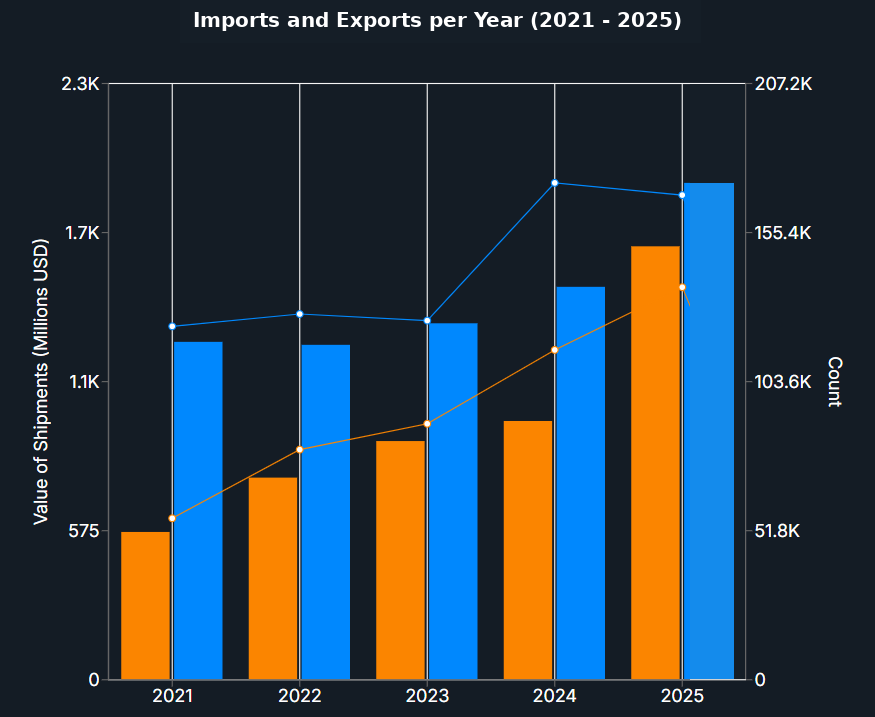
Figure 1: Cisco Systems Recorded Import and Export Activity, 2021–2025
Source: TenderAlpha Pro
Recorded trade flows activity increased over the 2021–2025 period. That sits alongside a much sharper increase in Cisco’s disclosed manufacturing and supplier commitments as its AI infrastructure business has grown.
The financial exposure has grown with it. Cisco notes that large commitments based on expected demand can create excess inventory or other costs if customers change orders or buying patterns. Memory costs are another pressure point.
Cisco therefore enters fiscal 2027 with stronger demand, but also with considerably more capital and procurement activity tied to delivering against that demand.
Revenue Growth Has Accelerated While Margins Remain Relatively Stable
Fiscal 2026 stands out against Cisco’s recent history.
Table 3: Cisco Revenue Growth and GAAP Gross Margin, Fiscal 2016–2026
| Fiscal year | GAAP gross margin | Revenue growth Y/Y |
|---|---|---|
| 2026 | 64.5% | 12% |
| 2025 | 64.9% | 5% |
| 2024 | 64.7% | -6% |
| 2023 | 62.7% | 11% |
| 2022 | 62.5% | 3% |
| 2021 | 64.0% | 1% |
| 2020 | 64.3% | -5% |
| 2019 | 62.9% | 5% |
| 2018 | 62.0% | 3% |
| 2017 | 63.0% | -2% |
| 2016 | 62.9% | 0% |
Source: Cisco Systems investor materials and annual filings.
The 12% increase in fiscal 2026 was Cisco’s strongest annual revenue growth across the period shown above, slightly ahead of the roughly 11% recorded in fiscal 2023.
Margins have been much steadier. Cisco’s annual GAAP gross margin has stayed within a fairly narrow range despite substantial changes in revenue growth and product mix.
The Q4 numbers also require a clear distinction between GAAP and non-GAAP performance. GAAP gross margin increased to 64.1% from 63.2% a year earlier. Non-GAAP gross margin moved the other way, falling to 66.3% from 68.4%.
Higher hardware mix and memory costs were among the pressures cited by Cisco.
Even so, non-GAAP EPS increased 23% year over year to $1.22 in Q4. For the full year, GAAP EPS rose 31% to $3.33, while non-GAAP EPS increased 14% to $4.33.
Fiscal 2027 will test how much of Cisco’s stronger top-line growth can translate through to earnings as AI infrastructure becomes a larger part of the business and the associated supply commitments increase.
Government Award Activity Has Picked Up in 2026
Government contracting is not the main driver of Cisco’s growth story, but TenderAlpha Pro records show a clear increase in award value associated with the company in 2026.
Table 4: Cisco Systems Recorded Government Award Value, 2021–September 2026
| Year | Recorded Award Value (USD) |
|---|---|
| 2026 YTD | $138,994,663 |
| 2025 | $36,920,706 |
| 2024 | $58,815,194 |
| 2023 | $35,267,228 |
| 2022 | $73,615,442 |
| 2021 | $70,849,335 |
Source: TenderAlpha Pro
Through September, TenderAlpha Pro records almost $139 million in Cisco award value, well above every full-year figure in the table since 2021.
The more interesting development, however, sits earlier in the procurement cycle.
In September 2026, the Defense Information Systems Agency published a notice stating its intention to establish a sole-source, single-award, DoD-wide Cisco Joint Enterprise License Agreement with Cisco Systems.
The proposed five-year arrangement covers Cisco software and licensing, hardware maintenance, cybersecurity, engineering services, training, hardware-as-a-service and centralized asset management. DISA describes the initiative as a way to consolidate Cisco licensing and increase the Department of Defense’s purchasing leverage across an existing Cisco technology footprint.
Following the opportunity through the next stages can show whether it develops into an award, how the scope changes, which Cisco entities are involved and what additional procurement activity follows.
It can also help separate one-off contract activity from something more strategic. A proposed DoD-wide enterprise agreement covering software, security, maintenance, engineering and hardware-related services has a different significance from a standalone equipment purchase.
None of that makes the future revenue certain. The notice is still pre-award. But it provides an earlier signal of a potential government revenue stream and a government relationship worth monitoring as the procurement develops.
Conclusion
Cisco enters fiscal 2027 with its strongest revenue momentum in years, and AI infrastructure is taking a much larger role in the business.
That growth is also changing the operating picture around the company. Purchase commitments with contract manufacturers and suppliers have more than doubled, while TenderAlpha trade flows show activity across semiconductor, manufacturing, logistics and distribution relationships around Cisco.
Government activity is smaller in scale but still adds another layer. Recorded award value has risen sharply in 2026, and the proposed DoD-wide Cisco agreement shows how procurement data can reveal potentially important government opportunities before they reach the award stage.
Taken together, the financial results, company relationships, trade flows and procurement activity give a broader view of where Cisco’s growth is coming from – and where some of the operational dependencies now sit.
Explore Cisco’s company relationships, trade flows, and government award history in TenderAlpha Pro. Request a demo.
This article is provided for informational purposes only and does not constitute investment advice or a recommendation to buy, sell or hold any security.