
Key Points:
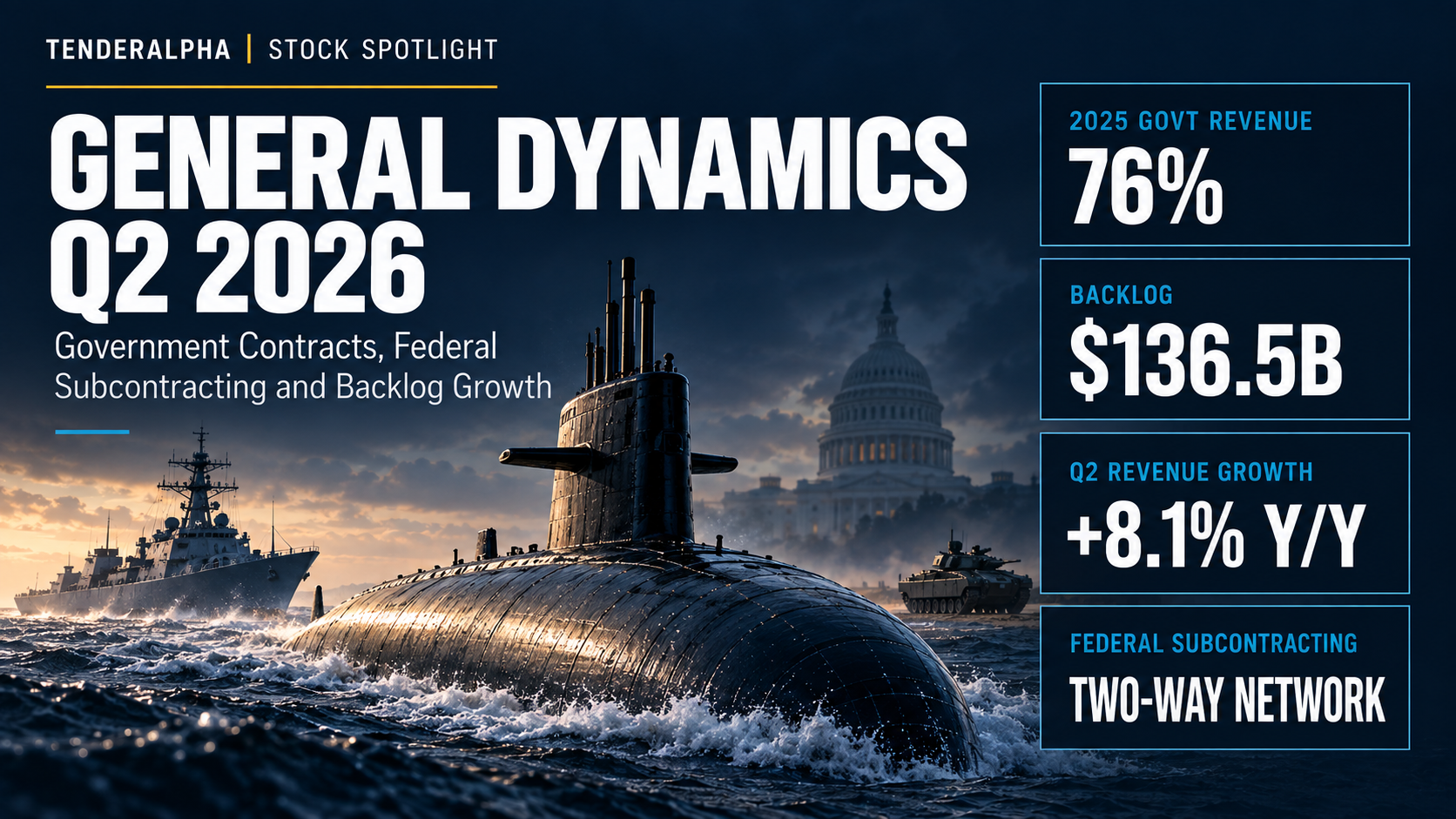
- Government customers accounted for 76% of General Dynamics’ 2025 revenue, including 68% from the U.S. government. TenderAlpha Pro records also show government award value associated with General Dynamics almost doubling between 2021 and 2025.
- TenderAlpha Pro’s U.S. Federal Government Subcontracting Data shows General Dynamics on both sides of the federal procurement chain, including two-way subcontracting relationships with major defense companies such as Lockheed Martin and Northrop Grumman.
- General Dynamics reported 8.1% year-over-year revenue growth in Q2 2026, while diluted EPS increased 13.4% to $4.24. The company also raised its full-year revenue, margin and EPS outlook.
- Total backlog reached $136.5 billion, up 31.7% year over year, extending the sharp backlog expansion recorded in 2025 and providing significant visibility into future activity across the business.
General Dynamics Government Contracts: Award Activity Has Increased
Government demand remains central to General Dynamics’ business. In 2025, 68% of consolidated revenue came from the U.S. government and another 8% from non-U.S. government customers. The remaining 24% came from commercial customers in the United States and abroad.
TenderAlpha’s government contracts data provides another view of this exposure through General Dynamics’ government contract awards. Recorded award value increased from approximately $16.4 billion in 2021 to $32.4 billion in 2025—an almost twofold increase over four years.
Table 1: General Dynamics government-contracting activity, 2021-September 2026
| Year | Recorded Award Value (USD) | Contract Records |
|---|---|---|
| 2026 YTD | $19.23bn | 2,351 |
| 2025 | $32.38bn | 4,267 |
| 2024 | $22.61bn | 4,536 |
| 2023 | $24.55bn | 4,873 |
| 2022 | $22.98bn | 4,994 |
| 2021 | $16.36bn | 4,728 |
The increase in award activity does not imply an equivalent increase in recognized revenue. The two measures capture different parts of the company’s government exposure: General Dynamics’ financial statements establish the importance of government customers to its revenue base, while TenderAlpha Pro shows how recorded government procurement activity associated with the company has developed over time.
The 2026 figure is also year-to-date and should not be compared directly with the full-year 2025 total. Government awards can be unevenly distributed through the year, making completed annual periods more useful for assessing longer-term trends.
TenderAlpha Pro also allows users to examine the government entities behind this activity. Major contracting entities associated with General Dynamics include the Department of Defense and its military departments, reflecting the breadth of the company’s exposure across shipbuilding, combat systems, technology and other defense programs. The platform provides contract descriptions and classifications alongside award and counterparty information, allowing the activity to be examined beyond aggregate value alone.
General Dynamics’ U.S. Federal Subcontracting Network
Direct government awards show only one layer of General Dynamics’ position in federal procurement.
U.S. Federal Government Subcontracting Data shows General Dynamics operating on both sides of the federal procurement chain: as a subcontractor to other major prime contractors and as a prime contractor connected to companies participating downstream.
Lockheed Martin and Northrop Grumman provide particularly clear examples. TenderAlpha Pro records show General Dynamics participating as a subcontractor under both companies’ federal prime activity. In the opposite direction, Lockheed Martin and Northrop Grumman also appear as subcontractors where General Dynamics is the prime contractor.
Boeing also appears on both sides of the data, although the relationship is more heavily weighted toward General Dynamics appearing downstream of Boeing prime activity. TenderAlpha records additionally identify companies such as Teledyne Defense Electronics and Aqua-Chem as subcontractors connected to General Dynamics’ federal prime activity.
Table 2: Selected General Dynamics U.S. federal subcontracting relationships
| Counterparty | General Dynamics’ Recorded Role | Relationship Pattern |
|---|---|---|
| Lockheed Martin | Prime contractor and subcontractor | Two-way federal subcontracting relationship |
| Northrop Grumman | Prime contractor and subcontractor | Two-way federal subcontracting relationship |
| Boeing | Primarily subcontractor in the recorded activity | GD appears more frequently downstream of Boeing |
| Teledyne Defense Electronics | Prime contractor | Teledyne appears downstream of GD |
| Aqua-Chem | Prime contractor | Aqua-Chem appears downstream of GD |
The underlying records also add context on the areas of federal activity associated with these relationships. General Dynamics’ subcontracting activity with Lockheed Martin, for example, appears alongside classifications including guided missile and space vehicle manufacturing, aircraft components, navigation and guidance systems, engineering and other defense-related work. Northrop Grumman records span missile-related manufacturing, shipbuilding, armored vehicles, engineering and technology-related classifications.
These classifications provide context on the federal contracts associated with the subcontracting records rather than necessarily identifying the precise product or service supplied under each individual subcontract.
The same data can also surface less visible companies further down the procurement chain. Aqua-Chem, for instance, appears as a subcontractor to General Dynamics in activity associated predominantly with shipbuilding and repair, while Teledyne Defense Electronics appears in records associated with areas including navigation, detection and guidance systems.
For investors and company researchers, this adds an important layer to direct government contracting data. Rather than looking only at the federal agencies awarding work to General Dynamics, the subcontracting data provides visibility into which companies appear alongside GD within reported federal procurement activity, which side of the relationship they occupy and the areas of government work associated with those relationships.
That can help analysts examine the wider company network surrounding major defense programs without assuming that every recorded subcontract represents a particular level of revenue or financial dependence.
General Dynamics Raises Its 2026 Outlook
General Dynamics entered the second half of 2026 with stronger financial performance as well.
Q2 revenue increased 8.1% year over year to $14.1 billion. Aerospace revenue grew 15.1%, while Marine Systems increased 10.4%, making the two segments the principal contributors to company-wide growth. Operating earnings increased 11.9% to $1.46 billion, and operating margin expanded 40 basis points to 10.4%.
Table 3: General Dynamics Q2 2026 segment results
| Segment | Q2 2026 Revenue | Q2 2025 Revenue | YoY Growth | Q2 2026 Operating Margin |
|---|---|---|---|---|
| Aerospace | $3.53bn | $3.06bn | 15.1% | 14.5% |
| Marine Systems | $4.66bn | $4.22bn | 10.4% | 7.3% |
| Combat Systems | $2.29bn | $2.28bn | 0.3% | 13.9% |
| Technologies | $3.62bn | $3.48bn | 4.1% | 9.4% |
| Total | $14.09bn | $13.04bn | 8.1% | 10.4% |
Diluted EPS increased 13.4% to $4.24, versus $3.74 in the prior-year quarter.
Following the stronger first half, General Dynamics increased its full-year outlook.
Table 4: General Dynamics updated 2026 outlook
| Metric | 2025 Actual | January 2026 Guidance | July 2026 Guidance |
|---|---|---|---|
| Diluted EPS | $15.45 | $16.10-$16.20 | $16.80-$16.90 |
| Aerospace revenue | $13.1bn | ~$13.6bn | ~$13.8bn |
| Aerospace operating margin | 13.3% | ~14.0% | ~14.7% |
| Marine Systems revenue | $16.7bn | ~$17.3-$17.7bn | ~$18.0bn |
| Marine Systems operating margin | 7.0% | ~7.3% | ~7.4% |
| Combat Systems revenue | $9.2bn | ~$9.6-$9.7bn | ~$9.8bn |
| Combat Systems operating margin | 14.4% | ~14.1% | ~13.8% |
| Technologies revenue | $13.5bn | ~$13.8bn | ~$14.1bn |
| Technologies operating margin | 9.5% | ~9.2% | ~9.4% |
| Consolidated revenue | $52.6bn | ~$54.3-$54.8bn | ~$55.7bn |
| Consolidated operating margin | 10.2% | ~10.4% | ~10.5% |
At approximately $55.7 billion, current revenue guidance implies growth of around 6% from the $52.6 billion generated in 2025. The $16.80-$16.90 diluted EPS range implies roughly 9% growth around the midpoint.
General Dynamics Backlog Reaches $136.5 Billion
Backlog provides another important part of the General Dynamics outlook.
Total backlog reached $136.5 billion at the end of Q2 2026, up 31.7% from approximately $103.7 billion a year earlier. The increase was broad-based: backlog grew 20.5% in Aerospace, 23.0% in Marine Systems, 77.1% in Combat Systems and 26.4% in Technologies.
The Q2 increase extends the unusually strong backlog expansion already evident in 2025. General Dynamics ended last year with $118 billion in backlog, up approximately 30%, after reporting a company-wide book-to-bill ratio of 1.5x.
Table 5: General Dynamics revenue and backlog growth, 2017-Q2 2026
| Period | Revenue Growth | Backlog Growth |
|---|---|---|
| Q2 2026 | 8% | 32% |
| 2025 | 10% | 30% |
| 2024 | 13% | -3% |
| 2023 | 7% | 3% |
| 2022 | 2% | 4% |
| 2021 | 1% | -2% |
| 2020 | -4% | 3% |
| 2019 | 9% | 28% |
| 2018 | 17% | 7% |
| 2017 | 1% | 2% |
The scale of backlog provides substantial visibility into work General Dynamics is contracted to perform, although backlog should not be treated as immediate revenue or as a guarantee of a particular growth rate.
Taken together, the higher 2026 outlook and continued backlog expansion point to a stronger operating position entering the second half of the year. The particularly sharp increase in Combat Systems backlog also broadens the growth picture beyond Aerospace and Marine Systems, which drove much of the Q2 revenue increase.
Conclusion
General Dynamics remains deeply exposed to government demand, with government customers accounting for 76% of 2025 revenue. TenderAlpha Pro adds another perspective to that exposure: recorded government award value associated with the company almost doubled between 2021 and 2025, while U.S. federal subcontracting data reveals relationships that sit beyond General Dynamics’ direct government awards.
Those records show General Dynamics participating on both sides of federal subcontracting activity. Lockheed Martin and Northrop Grumman have substantial two-way relationships with GD, while Boeing, Teledyne Defense Electronics, Aqua-Chem and other companies illustrate how TenderAlpha can trace relationships further through the federal procurement chain.
That intelligence adds context to an improving financial picture. General Dynamics raised its 2026 revenue, margin and EPS outlook after Q2, while backlog reached $136.5 billion following strong growth in both 2025 and the first half of 2026.
For investors, the combination provides two complementary views: company filings show the financial effect of demand and execution, while TenderAlpha Pro provides company-level evidence on the government customers, contract activity and federal subcontracting relationships surrounding General Dynamics.
Explore General Dynamics’ government contract awards and U.S. federal subcontracting relationships in TenderAlpha Pro. Request a demo.
This article is provided for informational purposes only and does not constitute investment advice, a recommendation to buy or sell securities, or an assessment of the suitability of any investment. Readers should conduct their own research and consult an appropriate professional adviser before making investment decisions.